Hope in Times of Plague
What Rises from the Rubble
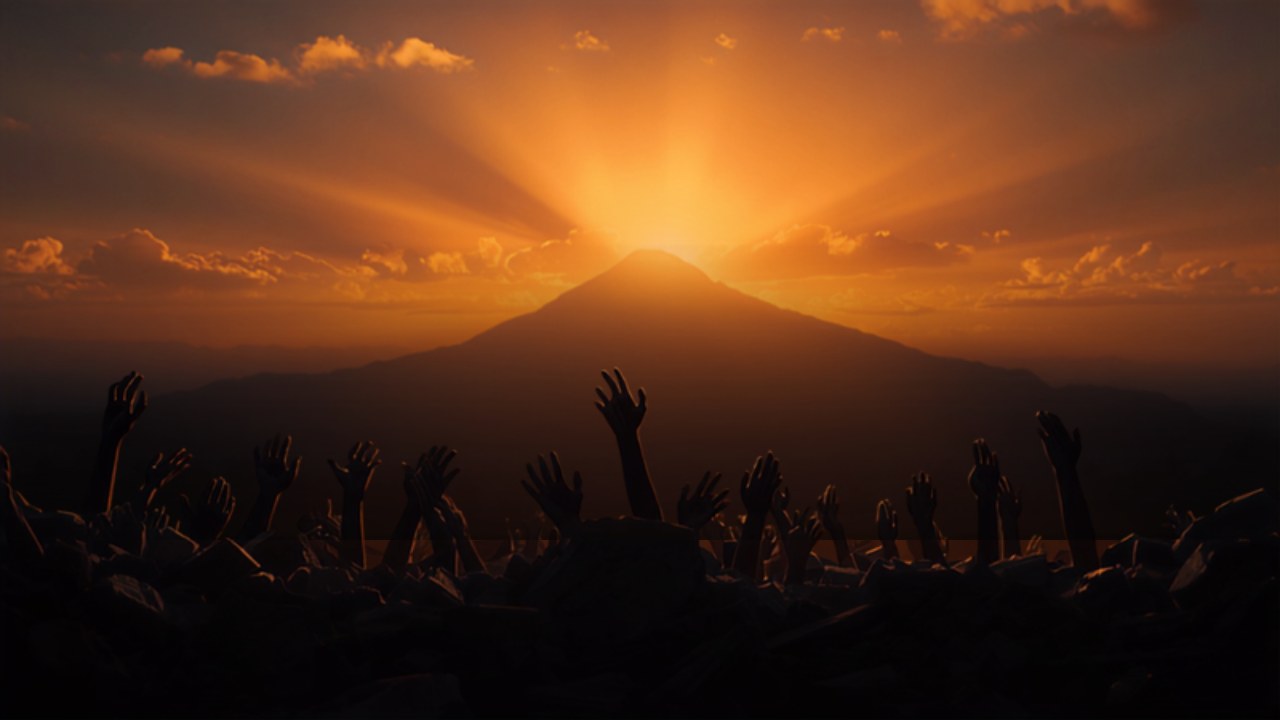
There is a book worth keeping close in the dark hours: The Plague, by Albert Camus. Few works have understood with such lucidity what happens when a city, a country, or a soul discovers that history can close over them like an iron door. Camus knew that the decisive question is not how to avoid suffering, because sometimes you can’t. The decisive question is how to remain human when everything collapses.
Camus understood something our age, with all its propaganda of well-being, tries to forget: happiness does not live outside tragedy. True happiness, when it appears, does not deny pain — it interrupts it. It is a lamp lit inside the night, not the abolition of the night.
But there are hours when even speaking of happiness feels almost obscene. Hours when a country is brought to its knees. Hours when death arrives not as metaphor but as rubble, as a collapsed hospital, as dust in the mouth, as a mother screaming a name among the ruins. In those hours, the word happiness sounds too clean for ground covered in blood.
We Venezuelans know those hours. We know them all too well.
Because our plague did not begin yesterday. It came first as a political and moral plague: the long, organized devastation of a country that once believed itself blessed with abundance. Plunder turned into method. Lies turned into the official language. Cruelty disguised as justice. A regime that destroyed not only the economy but confidence, continuity, the inner home of millions of people. That was the first plague.
Then came the second: exile. Because when a political plague lasts long enough, it ends up expelling the soul from its own territory. People do not leave only a country: they leave a childhood, a table, a mountain, a way of naming the world. They leave their dead. They leave their smells. They leave a house that, even when it no longer exists, keeps appearing in their dreams. And so Venezuela multiplied across the planet — Madrid, Miami, Bogotá, Santiago, Lisbon — while a secret part of the soul went on standing in line at Maiquetía, went on watching the Ávila, went on waiting for an impossible call that would say: you can come home now.
And now, on June 24th, came the third. The plague of the earth when it ceases to be ground and becomes a threat.
There were two earthquakes. First one, and thirty-nine seconds later — thirty-nine seconds, the length of an embrace, the length of time it takes to find a child with your eyes — the second, stronger still. It was a holiday: the day of Carabobo, on which we commemorate the battle that sealed our independence. That is why so many were at home. That is why home, that most sacred word, became for so many the trap. La Guaira, Caraballeda, Macuto, Naiguatá. Los Palos Grandes, Altamira. The names of our childhood turned into maps of rubble, with thousands of people still beneath them.
A country already broken by tyranny, already fractured by exile, now has the very earth open beneath its feet. And you ask yourself, without ornament: how much more can a people endure? How many plagues can fit inside a single history?
In moments like these, happiness seems impossible. But hope does not.
Because hope is something else. It is not optimism — optimism is usually just a polite way of not looking. Hope looks reality in the face: it sees the bodies, sees the hunger, sees the fear, sees the incompetence of power, sees the obscenity of a regime that shields itself while the people suffer. And even so, it finds, among the rubble, a reason not to surrender the soul. Hope is not born from things being well. It is born from seeing that, when everything is wrong, there are still human beings capable of acting well.
That is the revelation of every plague, and it is the one Camus placed at the center of his novel. The Plague tells the story of Oran, a city sealed in quarantine by an epidemic. Its protagonist is Dr. Bernard Rieux, an ordinary physician — no saint, no bronze hero — who decides to do the decent thing. He heals when he can. He accompanies when he cannot heal. He shows up each morning before the suffering and does what must be done. He does not defeat the plague entirely; he knows no one ever defeats it completely. But he denies it the right to turn him into an accomplice of indifference. And around him, without grand proclamations, brigades of ordinary people begin to form — men and women who risk their lives for strangers, not because victory is guaranteed, but because there are moments when decency does not ask about the outcome before it acts.
After looking head-on at all the horror the human being is capable of, Camus refused to give it the last word, and he wrote one of the bravest sentences of the century: that in men there is more to admire than to despise. He did not say it as a pretty consolation. He said it as a truth wrenched from the worst possible scenario. And on June 24th, that truth came true again on our own soil.
Because while the buildings were still settling into the dust — before any order arrived, any authority, any camera — the people arrived.
The neighbors arrived, with their hands, to dig for people who minutes earlier had been strangers. Convoys arrived at dawn from Valencia, having driven through the night to be there by sunrise, coming down the highway loaded with their own water, their own food, their own blankets, handing out what they had to those who had lost everything. No one sent them. They charged nothing. They did not ask how the person under the rubble had voted.
And then the world arrived. Rescuers from Mexico, El Salvador, Chile, Switzerland, the Dominican Republic. The Turks arrived, who know about earthquakes the way we know about exile. The French arrived, the Americans — more than twenty-five hundred men and women from distant countries who left their families to come pull the living and the dead from the broken earth of a country many of them could not place on a map. They arrived with dogs trained to smell life beneath the concrete. There was a young man of twenty-one, trapped for five days in Tanaguarena, and a Salvadoran doctor found a way to slip water to him through the cracks, to keep him alive while they dug. Five days of strangers wrestling with the rubble for a single life that was not their own.
And those who could not dig did something else: volunteers built, in a matter of hours, a website where families could post photos of their missing. An improvised altar, made of love and urgency, so that no name would sink into the silence.
This is what I want you to see. Not the headline. Not the figure, which always arrives late to the pain. I want you to see that bottle of water going down through a crack. I want you to see those broken hands digging. I want you to see a stranger refusing to abandon another stranger. There, in that gesture, begins the only hope that does not lie.
Because the plague reveals the worst — corruption, abandonment, cowardice, the obscenity of power that protects itself while others lie buried. But it also tears off the masks and lays bare the radical beauty of human nature when it decides not to close in on itself. Suddenly, in the middle of the disaster, someone appears who, able to withdraw and protect only what is theirs, crosses the line of fear and says: here I am. Here are my hands. Here is my time. Here is my bread. Here is my body, which trembles too, but which has decided not to leave you alone.
That phrase — here I am — is the true antidote to the plague. And notice what it is, at bottom: love turned into logistics. Compassion turned into a shift on watch. Goodness turned into food. Hope is not a pretty idea; it is a conduct. It is not an emotion; it is a verb. It is a stretcher carried. It is a bottle of water going down through a crack. It is a convoy at dawn. It is a common pot. It is a lit flashlight.
And to those of us who are far away — those of the second plague, who watch the house burn from the other shore of the sea and feel helplessness like a stone in the chest — this third plague taught us something exile had made us forget. We believed we had lost the country. And it turns out the country was alive, and it showed us so in the worst way and the most beautiful: trembling, and rising. Because a nation is not its government, nor its oil, nor its border, nor even its anthem or its patriotic dates. A nation is its people when they bend down to search for one another in the dust. That, no earthquake topples. That, no regime expropriates. That, no distance erases.
Terrible days are still to come. The numbers will rise; we know this already. There will be names that never appear, griefs that never close, buildings that will take years to become home again. The plague of the earth will recede, as all plagues recede, without ever fully disappearing: the fault will still be there, sleeping. Just as the fault of the regime is still there, and the fault of exile. Let us not lie to ourselves: history is not cured by an emotion. Reconstruction will demand years, justice, memory, institutions, truth. It will also demand that adult form of hope which is not content to be moved, but organizes itself.
But no reconstruction begins with cement. It begins with trust. And trust begins when someone helps. Every act of solidarity lays an invisible stone in the rebuilding of the country. Every volunteer says, without knowing it: there is still community. Every life saved says: there is still a future. Every outstretched hand says: the plague has not turned us entirely into what it wanted.
That is the thread. Thin, fragile, but real. The thread of hope. Not the naïve kind, the kind that believes everything will turn out fine just because. The other kind: the stubborn, the lucid, the dust-covered, the kind that has hands, a back, hunger, and sleeplessness. The kind that arrives with a flashlight. That hands out soup. That digs. That heals. That embraces the one who has just lost everything.
Tyranny tried to make us distrustful. Exile tried to scatter us. The earthquake tried to bring us to our knees. But solidarity says something else: that we are still a “we.” That beneath the political ruin, beneath the diaspora, beneath the split concrete, something they could not destroy goes on breathing. The deep country. The country that needs no permission to be worthy. The country that appears when someone asks: what do you need?
There is a scene that recurs in every catastrophe and contains an entire theology: someone trapped beneath the rubble, and someone outside digging to reach them. Between the two there is stone, dust, danger, time running against them. But there is also a voice. And that voice says the only thing that, in the end, matters. It is what a mother says to a child. What a rescuer shouts to a stranger beneath a fallen wall. What Venezuelans the world over want to say to our country, even from far away, even with our hearts broken, even without knowing when we will fully arrive:
Hold on.
We’re coming.
Gil Carrasquero, author of The Religion of Genius (forthcoming).
Originally published on Substack on 30 June 2026. View the original.