The Insight Is Not the Goal
On St. Ignatius, Jung, and the question that begins where the insight ends: what life will you live now?
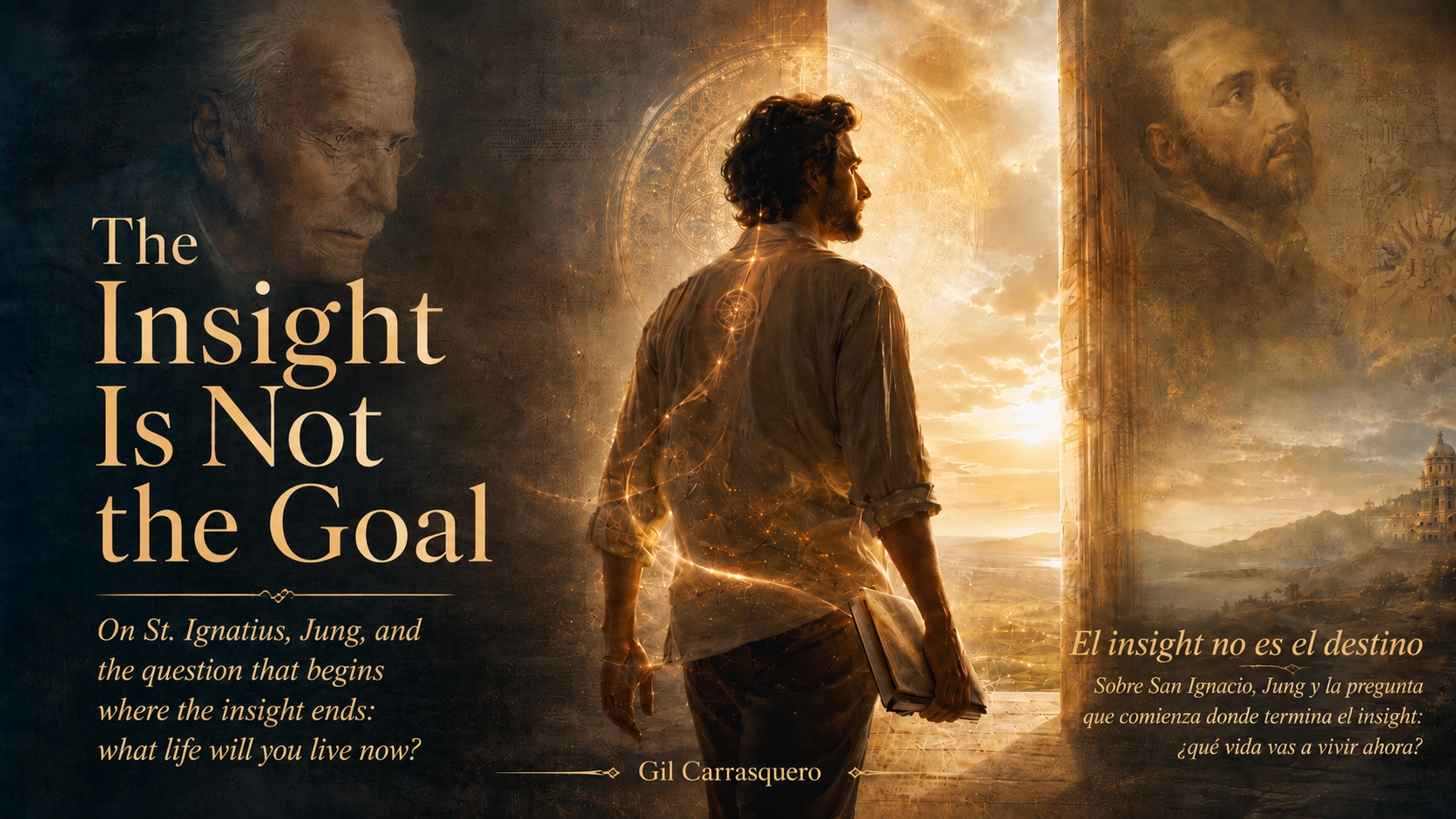
Imagine a man you keep meeting, in different cities, in different circumstances. Sometimes he has just returned from a retreat in the mountains and cannot stop talking about what he saw there. Sometimes the breakthrough happened in therapy, in year four, when the pattern finally showed itself and he wept uncontrollably in that session. Sometimes it was an entheogenic medicine ceremony, or a divorce, or a sentence in a book that found him at the exact hour he was ready for it. He tells you, with the particular glow of a man who has seen something true: everything is different now. He finally understands. And when you meet him again a year later, his life is exactly the same.
Same desk. Same marriage conducted through logistics. Same postponed conversation, now entering its sixth year. The insight has been added to his collection the way one adds a painting to a wall no one looks at anymore. He is wiser, and unchanged.
We have built an entire spiritual culture for this man. It sells him the insight as the goal: the awakening, the breakthrough, the download. It congratulates him at precisely the moment the old masters would have said the real work begins. Because the traditions that took the soul seriously, the ones that built actual technologies of transformation rather than experiences of it, agreed on something our age has quietly deleted.
The insight is not the destination. The life that follows it is.
· · ·
In 1522, a Spanish soldier whose leg and whose vanity had been shattered by the same cannonball retired to Manresa, where a cave became his cell, and spent the better part of a year in silence. What Ignatius of Loyola brought out of that cave was not a vision, though he had visions. It was a method: the Spiritual Exercises, a four-week discipline of the imagination that would train souls for the next five centuries.
Here is what almost everyone gets wrong about the Spiritual Exercises of St. Ignatius of Loyola, and what makes them permanently radical. They do not end in illumination. The First Week concerns sin, disorder, and mercy; psychologically, we might say it dethrones the ego and dismantles the false center. The weeks that follow contemplate a life that had direction, cost, destiny, and at their decisive hinge stands what Ignatius called the election: the choosing of a life. The exercitant is not asked how he feels. He is asked: What will you do with your life? How will you live differently? What commitment do you take on toward the future? What work do you owe the world? And the Exercises close, weeks later, with a contemplation on love whose instruction compresses this entire essay into one line: love ought to manifest itself in deeds rather than in words.
The Exercises are not designed to produce interesting interior states. They are designed to produce a decision.
Four centuries later, in the winter of 1939, with Europe catching fire for the second time in a generation, Carl Jung stood before a lecture hall in Zurich. He had spent months teaching on yoga and Buddhist meditation, the disciplined interior technologies of the East, and now he turned homeward with a question: had the West ever built one of its own? His answer was the soldier’s manual: the Spiritual Exercises of St. Ignatius of Loyola. And the title he chose for the lecture cycle tells you everything about what he found inside.
He called it The Process of Individuation. What stopped Jung inside the Exercises was, first, a sentence. It sits in the opening pages, so plain it is easy to read past.
Creatus est homo. Man is created.
Psychologically, Jung understood, that sentence detonates the modern ego. It says: you did not write the first line of yourself. Long before consciousness arrives, something is already moving. Certain fascinations. Certain wounds. Talents you did not choose. Books that found you. Dreams that arrived years before you understood them. Patterns that only decades later revealed themselves as a pattern.
The ego is late to its own life. Ignatius said it in religious language: your existence has an orientation that is not your invention. Jung translated it psychologically: consciousness discovers itself inside a process already underway. And the modern world said: forget all that.
It said so most brilliantly through Sartre, and he deserves to be heard at full strength, because he was not wrong about everything. Existence precedes essence, he declared. You arrive without a script. There is no fixed human nature, no God-given purpose, no destiny folded into you like a letter waiting to be opened. You are thrown into freedom, and everything you call your self is something you built. Man is nothing else but what he makes of himself.
Understand why this conquered the century. After the death of God, it restored dignity: no priest owns you, no fate excuses you, your life is your work. It was a liberation, and this essay will not pretend otherwise.
And Sartre was subtler than his slogan. He knew the givens are real: body, history, circumstance, what he called facticity. What he refused was that those givens amount to an inner direction, a telos, anything your life is for. Exactly there, we part ways. Because nobody who has raised more than one child believes the page arrives empty; temperament comes before language, the second child refutes the theory the first one let you keep, and the third revolutionizes everything all over again. Nobody who has watched their own fascinations, the ones that chose them in childhood and never once asked permission, believes that nothing was written there first. Not an essence. Not a script that cancels freedom. An orientation: a grain, the way marble has a grain. The grain does not contain the finished statue. It imposes conditions, resistances, invitations, and part of freedom is learning what kind of freedom the stone permits. You may carve almost anything, except against it.
Half of Sartre survives this, and we will come back for the half he keeps. Because if something in you precedes the conscious ego, an urgent problem appears, one our spiritual culture has almost stopped talking about. How do you distinguish the voice of that deeper orientation from all its impostors?
Follow your intuition, we are told. Trust the universe. Listen to your inner voice.
But what if the inner voice is fear? Ambition wearing robes? Loneliness? An old wound negotiating for attention? Desire disguised as destiny? Ignatius understood this problem four hundred years before psychoanalysis existed. Not every interior movement was divine, and the ones that flatter you most deserve the most suspicion. The task was never merely to listen. It was to discern.
A real calling survives interrogation. The four tests that follow are not Ignatius’s; they are mine, distilled from his tradition, from Jung, and from what this question has cost me. Ask whether it remains: fantasies rotate, but the summons keeps returning across the years, indifferent to your convenience. Ask what it costs: the impostor promises addition; a real calling, sooner or later, sends an invoice. Ask whether it integrates your life or merely inflates your ego. And ask, finally, whom it serves, because a call that ends entirely in yourself is usually not a call. It is a mirror.
And beneath the four questions, Ignatius placed the hardest requirement of all. He called it indifference. It does not mean apathy. It means becoming free enough of the answer you want that you might actually hear the answer that is there.
You cannot ask what your life wants from you while secretly adding: as long as I don’t lose money. As long as nobody thinks I’m ridiculous. As long as my marriage remains exactly as it is. As long as I don’t have to begin again. As long as I remain, in the eyes of the people who knew me before, successful. That is not discernment. That is negotiation. You cannot hear a calling while dictating the acceptable terms of the answer.
· · ·
And now we arrive at the place where St. Ignatius, Jung, and the man from the retreat part company forever.
For the man from the retreat, the insight is the summit. He came, he saw, he integrated. For St. Ignatius, even discernment was not the summit. Discernment was the middle passage, and the election its decisive hinge, because insight that does not become a life is, in his economy, unfinished. Unpaid. The vision must survive contact with Monday.
Jung agreed all his life, in his own register. Individuation is not achieved in the head. The unconscious can present the image, the dream can deliver the summons, the analysis can name the pattern, and none of it counts until it is lived. You do not manufacture your deepest self. You become responsible for it. The image must become a decision. The decision must become action. The calling must become a life, with an address, a schedule, a cost, and consequences.
We need two different words here. Call the thing that anticipated you the Daimon: the unique pattern that was already moving before your consent was asked, the orientation you keep meeting in your fascinations and your wounds. And reserve the word Genius not for talent, not for IQ, not for the exceptional few, but for something rarer and available to anyone: the answer made flesh. The Daimon calls. Genius answers. And the answer is never a feeling. It is a form: a work, a practice, a marriage, a company, a classroom, a manuscript, a way of living that did not exist before you built it and could not exist without you. The insight is not the goal. The incarnation is.
· · ·
So here, as promised, is the half Sartre kept. We are responsible for our becoming. But responsibility does not mean invention. A sculptor is responsible for the statue without having invented the grain of the marble. The deeper task is stranger than authorship: to discover what has been asking to become through you, to distinguish its voice from all the impostors, and then, and only then, to give it form.
Which is why the ending of this essay cannot be an idea. Ignatius would not permit it, Jung would not permit it, and neither will I. The election is not mystical fireworks. It is not finding yourself. It is not another season of journaling. It is a decision with a date on it. A phone call. A resignation. A canvas bought and stretched. A manuscript begun at six in the morning. The conversation you have postponed for five years, finally had this week.
Somewhere in your life there is an insight already several years old, fully understood, beautifully articulated, and still waiting to be obeyed. You know the one. It came to you in a therapy session, or a hospital corridor, or a cave of your own. It was true then and it is true now, it has been patient with you for longer than you care to admit, and you have owed something to life ever since.
What life will you live, now that you know?
Originally published on Substack on 31 August 2026. View the original.