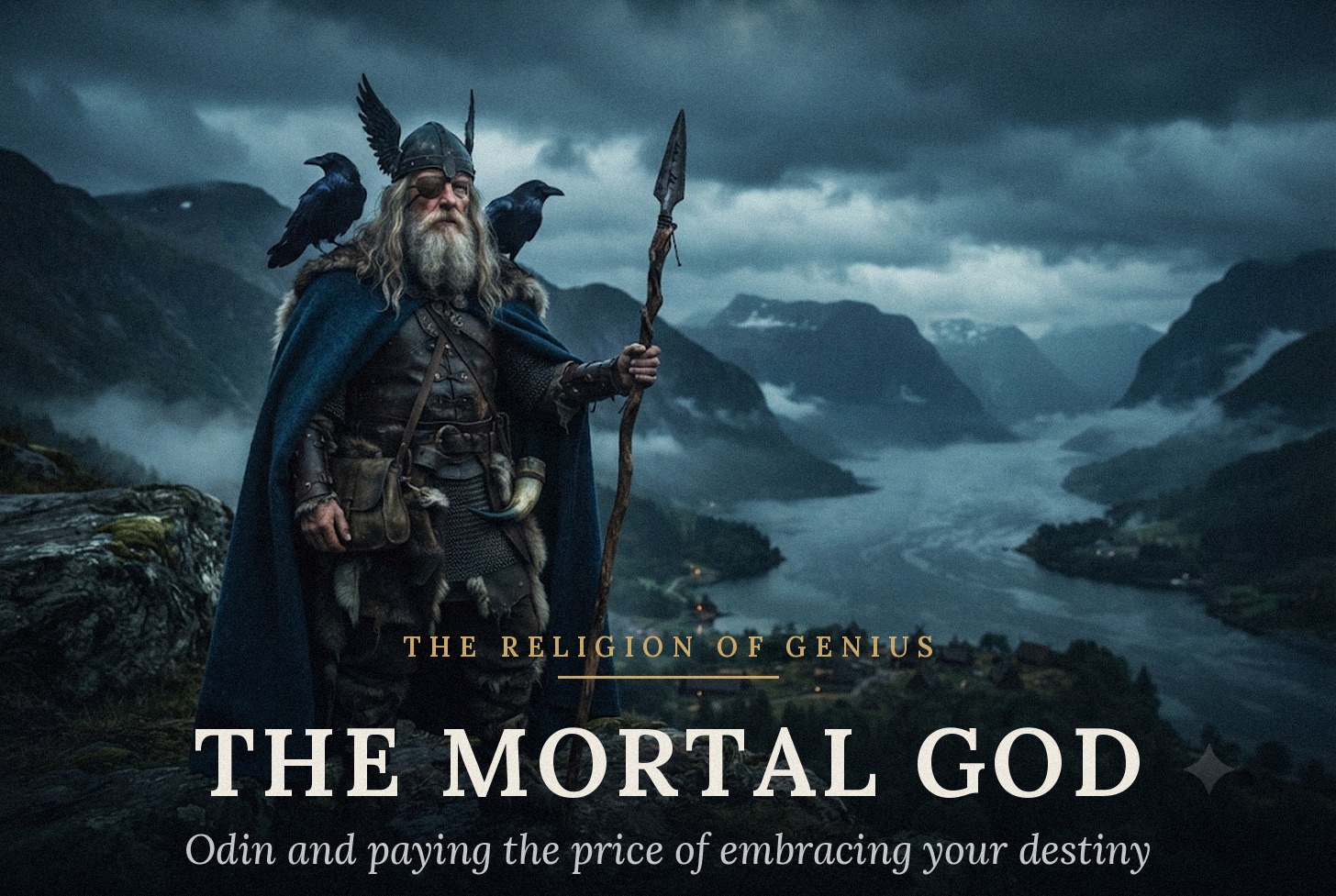
THE MORTAL GOD
Odin and paying the price of embracing your destiny
Last week I had just celebrated my birthday in Madrid when they announced the latest unbearable heat wave. Forty-two degrees: Madrid was to become an oven, and I hate extreme heat. I was deep in the writing of my book, The Religion of Genius, and I knew not one line would come in that furnace. So I did what the old Mediterranean peoples have always done when the gods of the south grow merciless. I fled north.
Iceland received me with amazing summer temperatures: early cooler mornings followed by eighteen-degree sunny days were exactly what I needed. I decided to let Iceland surprise me, and it surely did. On my first day in Reykjavik I walked into the National Museum, trying to forge an understanding of this culture and the making of this country, so that I could make sense of the wonders I was there to explore in the days that followed. There, at the very entrance of the museum, in a glass case, I met a god small enough to hold in one hand: a bronze Thor the size of a chess piece, a thousand years old, a god you could lose in the grass. The son, the thunder, doing what thunder has always done: announcing. Deeper in those rooms Odin, his father, waited, present in his own manner, in mentions and names and the tellings beneath the displays, a god made of words wandering between the cases. I had met that father before, though never properly. Twenty-six years ago at the Harvard Kennedy School I had the privilege of serving as teaching assistant to my dear and admired professor Dean Williams, who later built his entire theory of leadership around Odin: the god who leaves the throne room and travels the nine worlds in disguise, in a grey cloak and a wide hat, asking questions, because power distorts what it looks at and the only cure is to go and see. I loved the metaphor for years. Nevertheless, in the museum I realized I had missed the one fact about Odin that changes everything. Little did I know that Odin was a mortal god. He pays with his very life the price of becoming who he was destined to become. The realization sent me straight back to everything I had been writing in my forthcoming book: that one must pay the price of listening to the summons, of following the daimon’s command, of incarnating the Genius. My work had somehow followed me here, and that encounter with Odin became an image of extraordinary power, one that depicts like no other the enormous price of becoming who we truly are.
We usually imagine divinity as exemption from the human condition. Zeus does not age. Gods do not suffer; they do not earn their powers or their wisdom. The supreme god, in the theologies that raised us, is another name for immunity. The gods of the north lived instead beneath a sentence. They could be wounded, could hunger, could grow old without their magic apples, could watch a beloved son die and stand powerless to retrieve him. And they knew, because a dead seeress recited it to their faces in verse, exactly how they would end: the great winter, the burning of the worlds, the wolf for Odin himself. Here stands the first law of this tragic theology, and it spares no one, neither peasant nor poet nor king nor god: no being is exempt from the price of becoming what it is. Odin received nothing for being Odin. He became Odin by paying.
The north always begins with the price. Beneath one of the roots of the world tree lies the well of Mímir, whose water holds the deep memory of existence itself, and when Odin asked to drink, the keeper of the well named the fee without apology: an eye. The god tore it from his own face, placed it in the water, and drank. From that moment he walked the worlds divided between two kinds of sight, one eye reading faces, battlefields, weather and power, the other submerged forever beneath the root, reading what only the depths can read. And this is the wound of consciousness, because wisdom estranges. Once you have seen beneath appearances you can see the motives beneath the explanations, the fear beneath the aggression, the mortality beneath the triumph, and you become incapable of pretending that you have not seen. Every real calling asks for such an eye: a respectable ambition, an inherited morality, an identity approved by family and tribe, a profession that rewards you while slowly erasing you, surrendered because it has become insufficient. This is why vocation so often begins as disorientation. The old map still exists; you can no longer believe in it. Most people interpret this as confusion. The soul knows it as payment.
But the eye was only the first offering. Vision showed Odin the hidden order of things and gave him no means to speak it, and so he wanted the runes. An alphabet, yes, but a sacred alphabet is never merely marks: each sign carried a name and a field of force. Ice. Fire. Gift. Journey. Harvest. Necessity. Other oracles narrate; the rune pronounces. Here is ice, it says, stop pretending it is summer. Here is necessity, stop calling it misfortune. The runes do not flatter the one who consults them and they do not abolish freedom. They remove excuses.
Such an alphabet could not be learned from a teacher or stolen from a library, and so Odin hung himself on the world tree for nine nights, pierced by a spear, given no bread and no horn, with no companion beneath him and no promise the ordeal would succeed. In the Hávamál he describes it in three words that contain the whole architecture of a summoned life: myself to myself. No enemy forced him onto the tree. The one who offers and the one who is offered are the same being; the lesser god consents to die so that the greater god concealed within him can emerge. The ego experiences such a moment as catastrophe, because something it built and protected and called me is being taken. The deeper life experiences it as exchange: the successful self offered to the necessary self, the public identity to the secret vocation, the person who has survived to the person who must now live. And this sacrifice cannot be delegated. A teacher may point to the tree, an analyst may explain why it has appeared, a lover may refuse to abandon its roots. The tree recognizes only one body. Yours.
For nine nights he hangs where all authentic transformation occurs, beyond the reach of applause. Then he looks down, sees the runes, and seizes them with a scream, because revelation is rarely luminous; truth tends to enter as rupture, tearing the life that preceded it. He falls. And notice what he brings down: an alphabet. He returns carrying form, signs, the capacity to make the invisible legible, and that is the whole difference between suffering and initiation. Pain by itself carries no automatic wisdom; it can deepen a life or deform it. Initiation happens when suffering comes back bearing form: a poem, a law, a child raised differently, a nation served, a truth spoken clearly enough that a stranger recognizes his own life inside it.
Two ancient words let us name this sequence. The Greeks called the summons the daimon, the inner presence that carries the pattern of a life and interrupts your personality whenever the life you are living has become too small. The Romans named that same presence the Genius. Thomas Ring, however, in his Genius und Dämon, draws the line between them: although the two words run as equivalents from a philological standpoint, they differ from a phenomenological one. Culture, with extraordinary wisdom, has reserved the word genius for those few individuals willing to suffer through the process of incarnating the daimon. The genius is the one who, like Odin, agrees to pay the price of embracing destiny. Genius, then, is what the summons becomes on the far side of payment, when a human being gives it eyes, hands and a craft: the genius is the daimon incarnated. The daimon calls. The genius answers. Between the two stands the tree: the daimon is possibility, the genius is incarnation, and the distance between them is paid for in nights. And the tree settles an old confusion, because genius shares almost nothing with talent. Talent is an ability, and it will decorate any ego that feeds it. Genius is an obligation fulfilled. Talent asks what you can achieve. Genius asks what must be brought through you before you die. Many hear the summons and keep rearranging the furniture so they will never have to open the door. They want the runes without the hanging, the wisdom without the eye, the destiny without the death of the identity too small to carry it. The myth refuses the fantasy. Even a god must pay.
And the tree is only half of Odin’s story. The other half is the ending. He knew, in detail, from the seeress’s own mouth: the wolf Fenrir would break free, the gods would march out, and the wolf would swallow him. No hidden clause, no last-minute miracle, no theological escape. What does he do after hearing the sentence? He prepares. He wanders the worlds collecting wisdom, questions giants and the dead, gathers the fallen brave into his hall and drills them every dawn for a battle whose outcome has already been revealed. Call it futile and you have confused meaning with victory. The prophecy told him how he would die; it said nothing about how he must live before the wolf arrives. Destiny fixes the boundary. Character determines what is built within it. He knows the hall will burn and builds it anyway, knows the warriors will fall and trains them anyway, and his work draws its gravity precisely from the death that awaits it, because mortality is the furnace that makes creation consequential. An immortal can postpone everything; nothing he touches is at risk, so nothing he touches has weight. The book must be written because the hand will fail. The love must be spoken because the mouth will close.
Reader, this is your situation. You too have heard the prophecy, perhaps through the mirror, the body, the death of someone your age, the quiet arithmetic of the years. The wolf has your name, and the question was never whether it will come. The question is what it will find you doing. The north despised one answer so much they gave it a name: the man who died in his bedding, on the straw, went down to Hel, and the straw death, read at depth, is the death of the unlived life. It can occur decades before the body stops, whenever security replaces destiny and the respectable self succeeds in imprisoning the necessary one. A person can achieve everything the world rewards and still die on the straw: the house built, the account full, the title secure, the daimon unanswered, the runes never carved. We measure longevity and never aliveness; we congratulate people for surviving lives that required them to disappear. I write this as someone who stood a long time on that summit and knows its precise temperature.
One last thing, and it is the reason this essay had to come from Iceland. Much of what I have told you survives because one man on this island wrote a book. Two centuries after the old faith fell, a chieftain named Snorri Sturluson wrote the myths down, and when the king’s men murdered him in his cellar in 1241, unarmed and begging, he died the very straw death his gods despised. The book took him anyway. Eight centuries later a Venezuelan writer fleeing the Madrid heat stood on his island reading his gods, because so much of the Odin we know passed through that one man’s ink. Cattle die, says the Hávamál, kinsmen die, you yourself will die the same; one thing never dies: the word passed on each of the dead. The wolf takes the body. It cannot swallow the alphabet.
So take the myth home to whatever heat or winter you are reading this in. You are the mortal god. Something more than personal lives within you and has only your mortal life through which to enter the world; the daimon has no hands except yours, no voice except the one you lend it, no years beyond the ones allotted to your body. It can die unborn, and that is the one death worth fearing, because in choosing what to do with your remaining time you are deciding whether a particular form of being, entrusted to you alone, will ever enter existence at all.
Which death are you building toward, the battle or the straw?
Let the wolf come on the day the seeress named; nothing you do will move the date. But let it find you building. Let it find the eye already surrendered and the runes cut deep into whatever substance your life has handed you. Even a god must die. But first, he must become himself.
— Gil Carrasquero / The Religion of Genius
Originally published on Substack on 2 August 2026. View the original.