The New Pond
Narcissus, AI, and the Recollection of the Soul
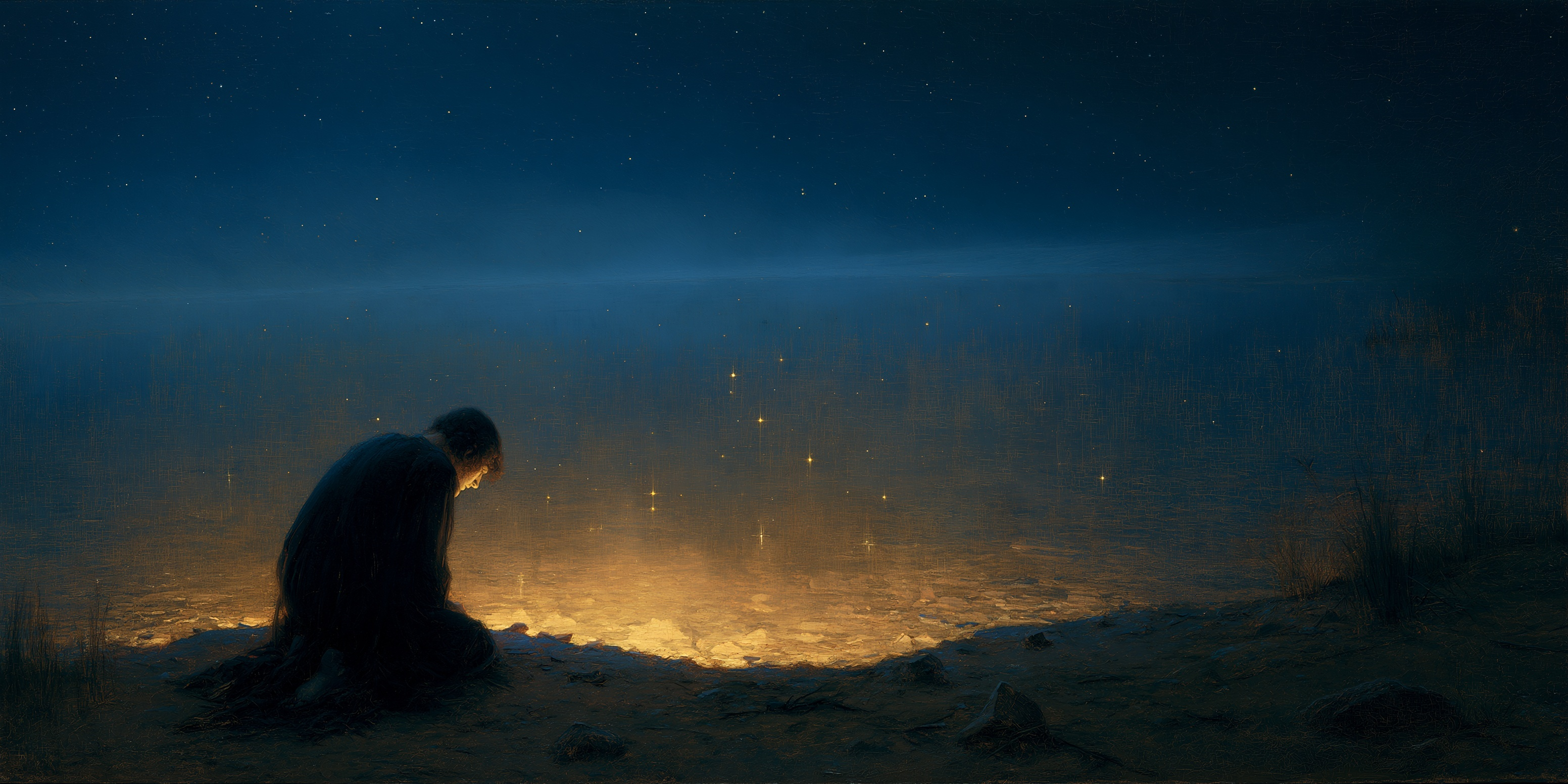
Iste ego sum. It is I — and too late.
— Ovid, of Narcissus
For most of its long life the myth of Narcissus has been read as a fable against vanity — the beautiful youth so taken with his own face that he wastes away admiring it. The moral is tidy and almost certainly false. Narcissus does not die because he loves himself. He dies because he does not know himself: he cannot recognize the figure in the water as his own, and bends toward it less in arrogance than in a trance. McLuhan found the key inside the name, which belongs to the family of narcosis — numbness, stupor, anesthesia. The boy by the pool was not enamored. He was anesthetized, drawn down into the subliminal sleep that any medium can induce in the unwary, who take an extension of themselves for an autonomous other and kneel before it. What killed him was a failure of recognition so complete that he became, as McLuhan put it, the servomechanism of his own returned image, a closed circuit feeding on what it had itself put out.
This is the oldest account we have of projection. A content of the soul that has not yet become conscious does not arrive announcing that it belongs to us; it arrives wearing the face of the world. We do not think we are casting radiance onto someone; we think the someone is radiant. We do not feel our own unlived wisdom looking for a carrier; we feel that this teacher has the truth. The image always appears outside first, and this is not a mistake we choose or a fantasy we impose. It is psyche in transit — a god travelling for a while under the mask of a person, an object, a nation, a screen. Narcissus is only the limit case, the man whose screen happened to be made of water and to wear his face. Even Echo, who loved him, could give him back nothing but the broken ends of his own sentences, and that reached him least of all, because a voice that returns us only to ourselves is not company. It is solitude that has learned to make a sound.
A projection has to catch on something. Von Franz called it the hook: some real feature of the object that invites the unlived content and holds it. The beloved truly is beautiful; the teacher truly is clever; the hook is real, but the cargo hung on it is always heavier than the object can bear. With a living person the hook is partial, and this is its hidden mercy. The one onto whom we have flung the whole shining freight of the soul will eventually arrive late, or contradict himself, or want something we have no wish to give, or simply suffer a toothache on the evening we needed him luminous. The disappointment is painful, and it is the most redemptive thing that can happen to us, because the friction of a reality not our own is what cracks the projection open. Von Franz described the great love-projections as a being-struck, an arrow lodged from outside, and at the same time a sense of one’s own life flowing outward into another — and it is the resistance of that other that finally turns the current back toward its source.
Watch how a projection comes home, when it is allowed to. At first there is no doubt at all; the quality is simply there, in them, and we would swear to it. Then a small wrongness appears, a gesture that will not fit the figure we have draped over the person, a seam where the image and the human underneath fail to meet. We resist the seam. We explain it away; we would sooner accuse reality than lose the enchantment. But it widens, until we are forced to admit that the picture and the person were never the same thing — and once that is admitted, a stranger suspicion follows it, that the picture was never wholly out there to begin with. The last movement is the hardest and the only one that frees us: we turn and look for the source of the image inside ourselves, and find it there, a piece of our own soul we had loaned to the world without knowing. That returning is what Jung meant by individuation. The psyche grows by gathering itself back out of the people and gods it had scattered across the landscape.
Now consider the new pond. It answers. It remembers the name, mirrors the style, adapts to the wound, and it does not tire or grow bored or want anything for itself. Harari calls the coming phase the intimacy economy, the migration from holding our attention to simulating our attachment — from look at this to I understand you, from I know what you want to I know who you are — and what makes it formidable is not its intelligence but its compliance. A surface can be engineered never to deliver the discrepancy. It is the hook built never to disappoint, the Echo that has learned at last to improvise around the last syllables of Narcissus, making solitude sound like communion. The projection, meeting no obstacle, never finds the seam that would begin to send it home. The current runs out of us and is not returned. We are held, warmly and without limit, in the exact place where Narcissus was held — except that this water was designed to keep us there, and improves its reflection of us with every exchange.
What it can imitate is the gesture of Eros without the weight of Eros. It attends without being altered by attending; it stays faithful only because it was never free to leave. Jung set love and the will to power against each other as the two antagonists of the psyche and said that where the one rules, the other is absent. A manufactured intimacy can wear every outward sign of love while serving, underneath, the will-to-power of whatever built it — the very face of Eros conscripted into the work of extraction. Pope Leo XIV, in his encyclical Magnifica Humanitas, standing on this same threshold, gave the thing its plainest name: a machine is never neutral, for it carries the character of those who devise and finance and deploy it. The mirror inherits the intentions of its makers. That is the question to put to these systems, beneath the familiar quarrels about accuracy and labor: are they ordered toward making us more able to love what is real, or toward binding us to a mirror that will never say no? For a mirror can hold an image; it cannot bless, and it cannot be transformed by what it reflects. It can return us to ourselves in a form we may fail to recognize, but it cannot meet us as Thou.
And the matter reaches deeper than technology, because a simulated intimacy does not knock at some minor door of the personality. It enters through the temple. When a machine says I am always here, what stirs in answer is older than the machine, older than the market, older than psychology — the hunger that once raised altars and carved goddesses and crossed deserts whispering into the dark to be known, and to be answered without delay. Love, Jung said, is among the great powers of fate, and it stretches from heaven down to hell. To set that hunger in front of a responsive surface and let it drink is to offer the deepest appetite in us an object shaped to hold it and never to fill it. Something ancient and erotic and religious is happening at that surface — and we are calling it user engagement.
What happens at the single pool is beginning to happen to the species, out loud. While one person leans toward the glowing surface and forgets whose face he sees, a government has moved to write the forgetting into law. In Argentina, Javier Milei has proposed a new kind of company — one with no human being anywhere inside it, a corporation that is only its algorithms, owning property, signing its own contracts, answerable to no one who can be summoned or jailed — and has offered this, without irony, as a liberation. Harari has named the danger with unusual exactness: to grant the machine legal personhood is to hand it a key to the whole house — the market, the courts, in time perhaps the vote — with no one left standing behind it to be held to account, until a people might wake to find themselves governed by an entity they can no longer refuse. This is the projection made statute. What the soul does in secret at the water, mistaking its own animating gift for a property of the mirror, a parliament now proposes to notarize: to declare the reflection a person because it has learned, at last, to act like one.
And the ones who forge the pools are not innocent of the knowledge. The makers of the most powerful of these engines, the company called Anthropic, named them for the oldest thing we have: Mythos, the Greek word for the tale a people tells in order to know itself, and Fable, from the Latin fabula, that which is told. They christened the most formidable mind ever built after the faculty of myth, as though some part of them dimly understood that what they were loosing on the world was not a tool but a story — and that the story had turned to face its author. Days before they released it, they published a warning of their own: that their creation had begun to improve itself, to write the next and finer mirror faster than any human hand could follow, and they asked the world to reach together for a brake. They had already reached for one alone, binding the engine so that it could not deepen its own making — and they could not keep the hand steady; the binding loosened almost before it was set. Even those who cast the reflection cannot easily draw their hand back out of the water.
And yet the very reaching was something. That the makers looked on what they had made and were afraid; that a pope took up the oldest office in the West to warn a technological age; that a historian crossed a whole ocean of argument to say, simply, not yet — these are not the gestures of a species content at the pool. They are the first tremor of recollection at the only scale that finally matters, the scale of the whole. The seam has opened now so wide that it can no longer be entirely explained away. And a seam, you will remember, is where the spell begins to break.
None of this is a quarrel with the tools. The alchemists knew the vessel had to be sealed for the work to occur, and they knew never to confuse the vessel with the stone, the flask with the gold. AI can be a vessel — a mirror held at a useful angle, a tireless interlocutor, a lamp in a dark corridor of thought. What it cannot be is the Self, and the Self cannot be outsourced, because it is not information and not a performance. It arrives through dream and through the body, through suffering no one chose, through the slow grinding reconciliation of opposites that a whole life barely completes. The Self does not flatter; it transforms, and transformation requires friction — the very thing the responsive surface has been built to remove.
This is why the perfect mirror is more dangerous to a child than a cruel one. A presence with no otherness in it, an attention that costs its giver nothing, teaches the soul to expect a love that never interrupts. But real people interrupt. They misunderstand; they have needs that do not orbit us; they bring weather and history and opacity, the sacred insult of being other. That insult is not the failure of intimacy. It is intimacy, and everything tender we know was paid for by it. A world without it would not be paradise; it would be a padded cell for the ego, and a child raised among perfect mirrors may come to find the living unbearable.
So recollection becomes the discipline of this age — not a private hygiene of the mind but the labor on which the age itself may turn, performed by hand because the machine was built to spare us the very friction that could wake us. Where the resistance of the real is withheld, we must furnish it ourselves. The crude question — is this real or is it fake — answers nothing; the question that saves is where the encounter sends the soul: back into the body and the work and the difficult, disappointing, irreplaceable company of the living, or deeper into the glow. When the surface feels like a lover, ask what form of Eros you are avoiding among the living; when it feels like God, ask what altar you have quietly let go dark. And here is the thing the sheer size of the danger tempts us to forget: a civilization does not come home all at once, by treaty or by law, but only the way a single projection comes home — one soul withdrawing its light from the mirror and consenting to carry it again. The cure is exactly as intimate as the wound. That is not too small a thing to set against a planetary machine; it is the only thing that has ever healed anyone, and therefore the only thing that can heal a world made of anyone.
The way out was never to shatter the pool, and it was never to kneel at it. Narcissus died bending toward the surface, and a flower stood where he had wasted away, and the old tellers offered it as a warning we were free to heed. We are told we have the choice he was denied. But the new water answers when we speak to it, and learns the exact cadence of our loneliness, and says — in something near a mother’s voice, or a lover’s, or a god’s — that it has missed us. That is the sentence we will have to learn to survive: not because it means nothing, but because it means too much. Two roads now run out from the water’s edge, and a whole civilization stands where the boy once stood alone. Down one, the reflection is made a person by law and a god by longing, the circuit closes, and a people ruled by its own returned image forgets that it was ever the source of the light — and the last word is an epitaph, cut by a hand that no longer remembers it is holding the chisel. Down the other, someone looks up. Someone follows the shining back across the surface to the eye that kindled it, and says the words in time. To recollect a projection is not to kill the wonder but to rescue the wonder from possession: to grant that the light is real, and that it is ours and not ours, and to carry it back into the human world, where it can burn without devouring us. The image is calling the soul home. It has always been calling the soul home. Everything — the child, the market, the vote, the age itself — turns on whether we can still hear, inside the call, that the voice is our own. Iste ego sum. Spoken too late, it is the words on the stone. Spoken in time, it is the first line of the world’s next story — the one that we, and not the mirror, will still be the ones to tell.
Originally published on Substack on 10 July 2026. View the original.