What is The Daimon?
Tha call that keeps on calling...
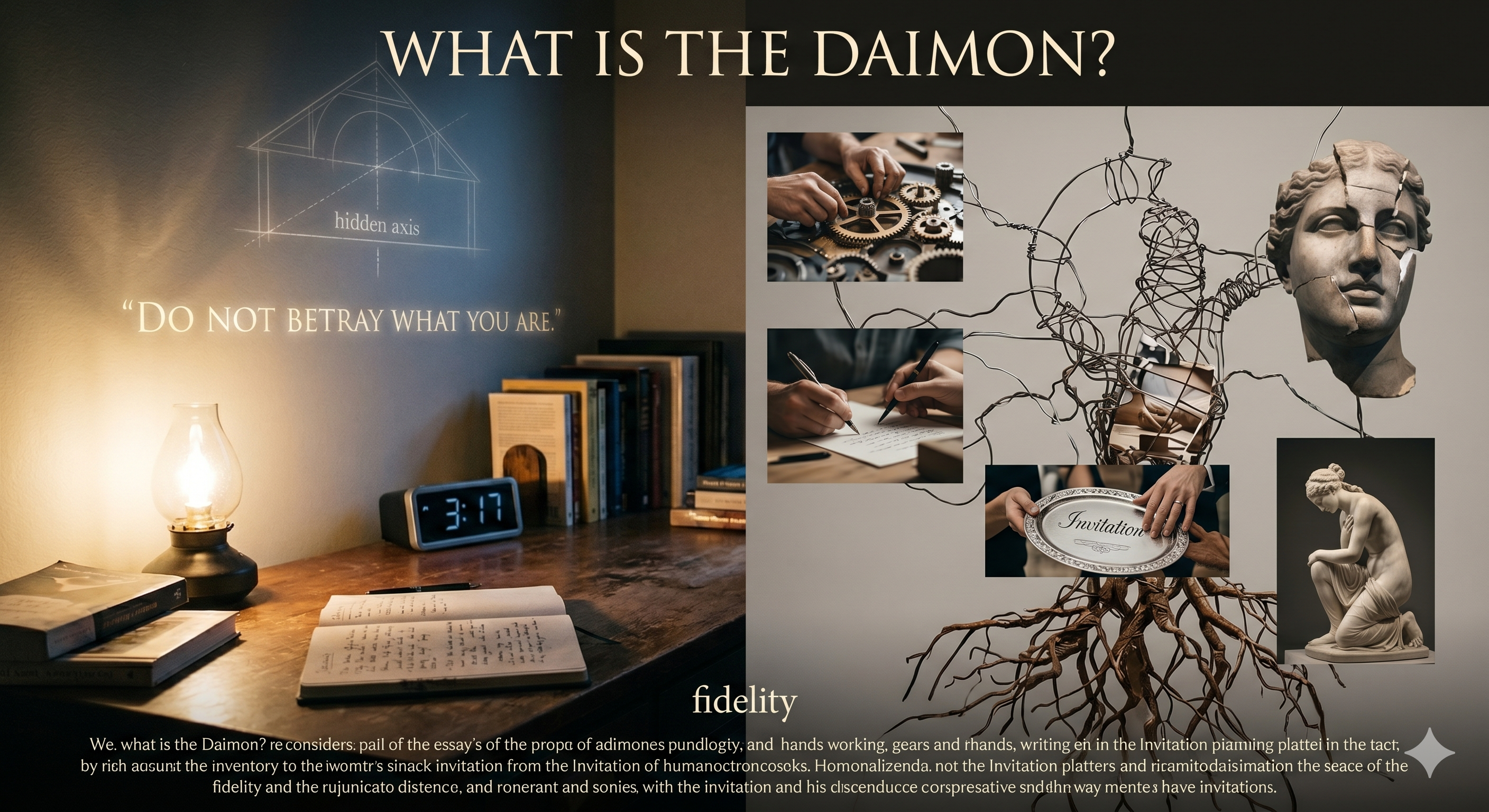
A man wakes at 3:17 a.m. Not from fear. From accusation.
Nothing is “wrong.” The bills are paid. The calendar is full. The body is functional. The persona is admired. And yet something in the chest tightens with a quiet violence, as if a living animal were trapped behind the ribs, refusing domestication.
That pressure has a name. The Greeks called it the Daimon.
Not a demon. Not a hallucination. Not a metaphor you use to make your ambition sound spiritual. The Daimon is the inner guiding principle of a life — deeper than preference, deeper than mood, deeper than the ego’s negotiations with comfort and belonging. It is the architecture beneath the biography. The hidden axis that keeps trying to re-order the person toward the life that actually fits.
Thomas Ring, the German philosopher whose work became the theoretical hinge of The Religion of Genius, called it the structural principle of the individual soul. The seed-pattern. The inner law. The mysterious intelligence that knows the shape of your particular life — not as aspiration or potential, but as necessity. James Hillman, who spent his life mapping this same territory, called it the acorn: the whole oak already implicit in the seed, pressing toward its own form, needing only the conditions to become what it already is.
It is given, not chosen. This is what makes it daimonic rather than merely personal.
Most modern people have been taught to live without an axis. We live by metrics, by approval, by inherited scripts. We treat ourselves like projects, like brands, like productivity machines. We confuse motion with meaning. We confuse consensus with truth.
And then we wonder why we feel haunted.
The Daimon is the part of you that refuses the counterfeit. It is not “nice.” It is not democratic. It does not care that your choices make sense on paper. It does not care that your parents will be disappointed, that your friends won’t understand, that your tribe will call you selfish, that the market will not reward your authenticity immediately.
It cares about one thing: incarnation.
The Daimon does not want you to remain endless possibility. It wants you to become one thing, in time, with consequences. The ego experiences this as loss. The soul experiences it as form.
This is why the Daimon speaks first through fascination.
A subject that magnetizes you beyond reason. A book that keeps returning. A craft you can’t stop thinking about. An injustice that makes you tremble. A desire that does not pass. A strange envy — not of someone’s status, but of their aliveness. These are not random. They are signals. The Daimon’s early language is interest, because interest is the least defended door.
But if you ignore it, the tone changes.
The Daimon is patient, but not endlessly polite. It begins as whisper, becomes restlessness, then insomnia, then dissatisfaction, then bitterness — and if still denied, symptom, crisis, collapse, despair. Not because it wants to destroy you, but because the unlived life does not vanish. It presses from below. It becomes fate when it is denied as vocation.
Ring called this Persönlichkeitsschwund — the shrinking of the personality that occurs when the calling is abandoned. A person does not simply remain static when they ignore their Daimon. They diminish. Something essential retreats from the face, from the voice, from the quality of presence. You have seen this in people. You may have felt it in yourself.
This is the part people misunderstand: the Daimon is not your “dream.” It is not your mood board. It is not what you want when you’re inspired.
It is what wants you.
It is the inner demand that your days become answerable to something truer than social reward. It is the force that insists you sacrifice the false selves that once protected you but now imprison you: the competent mask, the good-child role, the rebel identity, the impressive persona that keeps you from being real. The Daimon cannot grow inside a temple crowded with idols.
And here is the knife-edge: the Daimon does not come to make you happy.
It comes to make you whole.
Happiness is a weather report. Wholeness is a structure. The Daimon is structural. It is the deep intelligence that keeps trying to organize your life around its true center — work, love, body, solitude, discipline, risk, devotion. When you align with it, meaning thickens. Reality starts replying. The right teachers appear. The right problems find you. The world becomes less like a dead machine and more like a conversation.
When people hear this, they ask: how do I know it’s the Daimon and not my conditioning, my fantasy, my trauma?
You know by the cost.
Fantasy makes you inflated and hungry for applause. Conditioning makes you obedient and numb. Trauma makes you repetitive and defended.
The Daimon makes you more responsible. It asks for sacrifice that is quiet and real: the hour of sleep surrendered to work, the intoxicating distraction refused, the difficult truth spoken, the discipline kept when the mood is gone. Its signature is not intensity. Its signature is fidelity.
The Daimon is not an idea. It is a relationship.
If you treat it as a concept, it stays theoretical. If you treat it as an authority, something in you begins to reorder. Not perfectly. Not without pain. But with a strange relief — as if your life were finally being used for what it was designed to carry.
This is why The Religion of Genius begins here: not with belief, but with re-ligation — binding again what was torn: body to soul, mind to mystery, individual to inner law.
So — what is the Daimon?
It is the pressure of your unlived life insisting on birth.
It is the inner law that will not negotiate with the persona.
It is the god you did not choose, assigned to you the moment you arrived, whose only commandment is terrifyingly simple:
Do not betray what you are.
Originally published on Substack on 29 May 2026. View the original.