Dionysus at Taormina
Reflections from Sicily: on the urgency of giving ecstasy back its sacred precinct
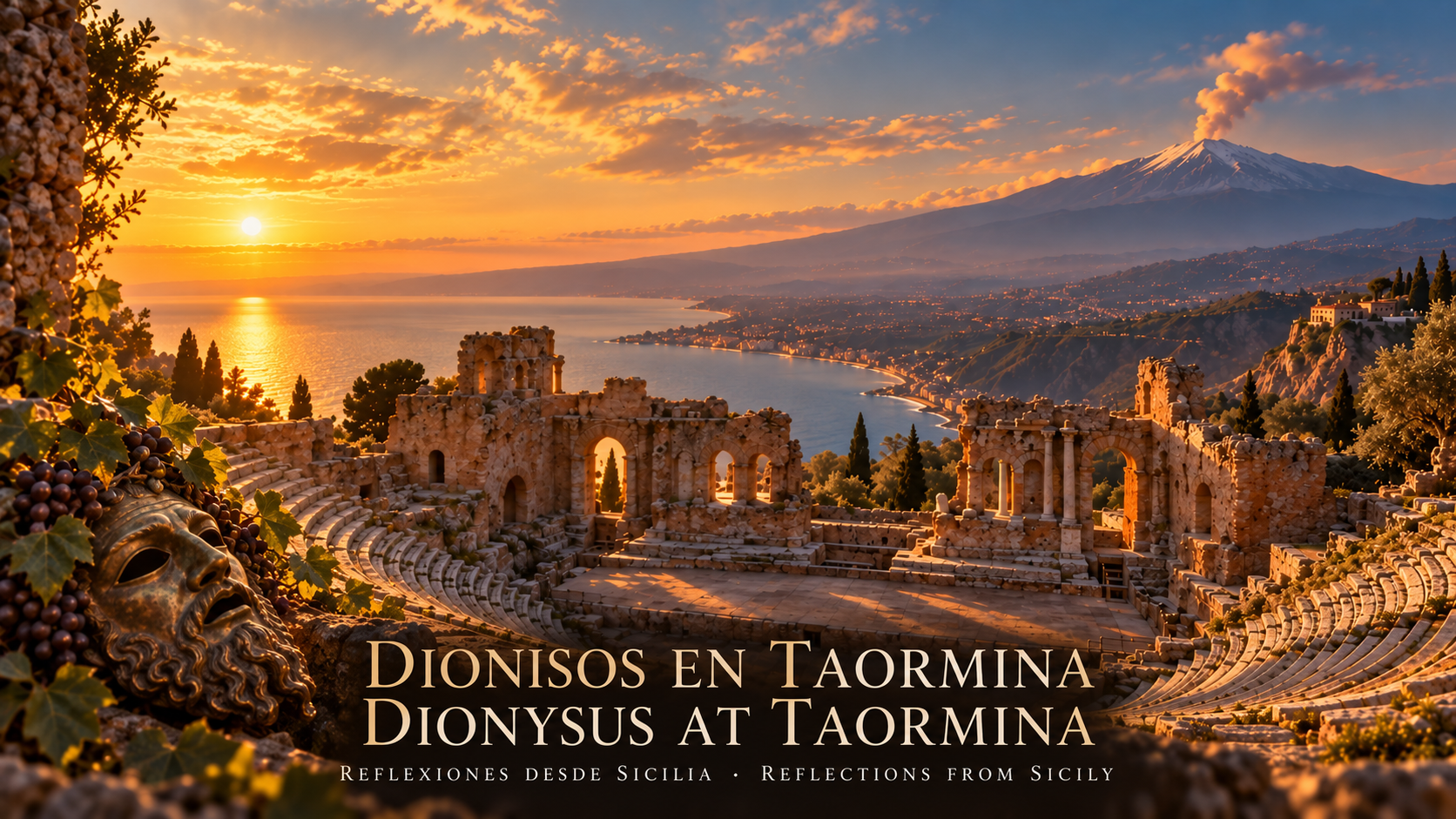
I am utterly enchanted with Sicily. I have spent this week crossing the island, and I began at Taormina, at the ancient theatre, and from the moment I sat down on that tier of stone I have not been able to stop thinking. You climb a path polished by two thousand years of sandals, pass through the Roman wall, and the half-circle opens all at once onto the sea. The orchestra falls away toward a coastline that runs on to Calabria, and behind the stage, in the place where any other theatre in the world would hang a curtain, stands Etna with its plume of quiet smoke, like a god having a cigarette. I walked the upper tiers with the feeling that I was not alone, and I do not mean it as a tourist’s piety. In that place the centuries keep you company. You walk with twenty-three hundred years of men who sat on that same stone to look at the same thing, and the same thing is still there, indifferent to the fact that we have forgotten how to look at it. Culture and nature meet at Taormina as they meet nowhere else I know, and in that meeting a reflection I had been half-making for years arrived whole and all at once.
The theatre at Taormina is three theatres. The Greeks raised it in the third century before Christ for tragedy, on a headland where sea and mountain were already present, though we cannot say how much of them the ancient spectator saw. Centuries later the Romans rebuilt it, put up a stage wall that shut out the landscape, and turned the orchestra into an arena for gladiators: where the god had once arrived, blood now ran. Then time did its work. The wall collapsed, and through the breach the ruin left, Etna came back in, so that the view that takes our breath away today is in part the work of destruction. Rome raised the wall, the centuries broke it, the mountain returned. And in May of 1787 a man climbed alone to the highest tier, Johann Wolfgang von Goethe, and noted that this was an immense work of nature and of art, and that never had an audience in any theatre had such a spectacle before it. The next day, under an orange tree, he began to dream a tragedy about Nausicaa that he never finished. Three theatres within a single enclosure: the Greek, where the god came; the Roman, where the god was replaced by spectacle; and the Goethean, where a modern man, without chorus and without rite, receives the epiphany straight from the landscape and goes home wanting to make myth again. You do not need to go to Broadway to read the history of what we have lost. It is written in the stone, layer upon layer, and I was standing on top of it.
It is worth remembering what the Greeks were doing there, because the word theatre misleads us. Tragedy was born from the cult of Dionysus, one of the strangest gods in the Greek pantheon, a god who even among the Olympians always seems to arrive from outside. Walter Otto, who gave him the book that remains one of the great guides to his nature, insists that Dionysus is above all the god who comes, the god of epiphany, whose essence is irruption. The other gods seem settled into the order of the world; Dionysus arrives, and when he arrives the order shifts. His great symbol is the mask, which unlike the statue has no back: it does not represent the god but makes him present, pure face, a gaze that comes at us with no interior to withdraw into. From that mask came the actor. From the god came the chorus. From the chorus came tragedy, and with it the extraordinary idea that an entire city could sit down to contemplate its own abyss.
To understand what that chorus was doing, one has to give a word back its weight. Ecstasy comes from the Greek ekstasis, to stand outside oneself, and its twin is enthousiasmos, to have the god within; the Greeks knew these were the same thing seen from two sides, because only when one has stepped out of one’s place is there room for something larger to step in. That is Dionysian ecstasy, and it is not an ornament of the rite but its highest function: the ego, with its small vigilance and its small story, stands aside for a few hours, and through the gap comes what Jung would call the totality of the psyche and the Greeks called the god. The wine, the dance, the cry of the chorus, the mask that erases the neighbor’s face, all of it was arranged to produce that going-out-of-oneself collectively and in order. And here is the thing the moderns forgot first: the Greeks, who knew what the god could do, set him limits. They gave him a precinct of stone, a few days a year, a calendar, a chorus in metre, and at Delphi they gave him Apollo’s temple for the three winter months when the other god was away, so that ecstasy and measure took turns under one roof. Euripides staged what happens when the limits fail from the other side: Pentheus, the king who denies the god and bars the city to him, ends torn to pieces by his own mother on the mountain. And they set him the wisest limit of all, which was laughter: every day of tragedies had to close with a satyr play, and the city that had just followed Oedipus into blindness stayed in its seats to watch drunken, priapic satyrs make fools of themselves, because no one was to go home straight from the abyss without passing through the belly laugh. Ecstasy without form tears apart; form without ecstasy suffocates. Tragedy, with its satyr at the end, was the exact place between the two.
What happened in the theatre was a rite before it was an art. At the Dionysia, Athens gathered to let itself be run through by everything that had to stay contained the rest of the year: madness, murder within the family, incest, vengeance, the fall of the king, the collision of law and conscience, the human will breaking against what it cannot control. Aristotle called what happened there catharsis, and whole libraries have been written on the word because it can mean purging, purification or clarification, and perhaps something of all three. What matters is that the Athenians did not climb the hill only to have something explained to them. They climbed it to undergo it, to follow Oedipus into blindness, Antigone into the cave, Agamemnon into the bath, to suffer in another’s person what, lived literally, could have destroyed them. And from that suffering came a knowledge that would have entered by no other door, because it entered through the body.
Nietzsche understood that mechanism better than almost anyone. The Attic public, he says in The Birth of Tragedy, did not simply sit facing the chorus: it recognized itself in the chorus. The citizen did not consume a story; he entered the myth and came back. Apollo gave the experience its form, the verse, the mask, the measure, the beauty that lets one look at horror without being blinded by it; Dionysus did the opposite and the complementary thing, dissolving for a few hours the boundaries of the individual and drawing him into something greater than himself. Tragedy was born of that tension, and Nietzsche saw its rupture too. With Euripides and Socrates the theoretical man appears, the one who begins to suspect that everything can be understood and, if understood, perhaps corrected, and the rite starts giving ground to explanation. Seventeen years after publishing that book, the man who had spent the better part of his life thinking Dionysus signed some of his last lucid letters with the god’s name. One should not be in a hurry to explain that coincidence.
Carl Gustav Jung took up that intuition with more caution. In Symbols of Transformation he recalls the impression made on us when, amid the noise of a modern city, we come upon a Corinthian capital embedded in a wall, and he compares that jolt to the recognition that Oedipus, “that perennial highlight of the Greek theatre,” still describes something that happens to us. And he adds that what aroused horror in the Greeks still remains true, but is true for us only if we give up the vain illusion that we are different, which is to say morally better, than the ancients; a few lines later he says we realize with astonishment that Oedipus is still alive for us. That is the enduring life of the classics, and it does not consist in their being old and beautiful, nor in their having outlasted the centuries, but in their describing a drama that has not ended because the psyche that produces it has not ended either. Jung goes further in the same book: what is essential in the mythic drama is not the particular figures, he says, but that a sacrifice takes place, a transformation in the unconscious that clothes itself in whatever images a culture has to hand, as dancers clothe themselves in animal skins. Greek theatre was perhaps the most dignified garment the Western psyche ever gave that sacrifice. When the garment is lost, the sacrifice does not cease; it goes on happening, but naked and nameless, and then it is no longer called tragedy.
It is called a symptom.
After Taormina I went down to spend a few days in Ortigia and Syracuse, and there I found the most extraordinary cultural syncretism I have seen in my life. In the cathedral of Ortigia the Doric columns of the temple of Athena, raised in the fifth century before Christ, still hold up the church, embedded in the walls of a building that was a mosque under the Arabs, a basilica under the Normans, and a Baroque façade after the earthquake: twenty-five centuries of different gods praying under one roof, none of them having quite managed to evict the one before. And a few minutes from there, in the archaeological park of Neapolis, Syracuse gave me the other half of the thought. There, separated by a few hundred yards, stand the Greek theatre, cut into the living rock of the hill in the fifth century before Christ and enlarged by Hieron, where Aeschylus himself staged plays and in whose shadow, in Sicilian earth, he lies buried, and the Roman amphitheatre of the imperial age, one of the largest in Italy. At Taormina the history was stacked and had to be read in layers; at Syracuse it is laid out before the eyes, and it is enough to walk from one building to the other to feel that something changed. The Greek theatre is a half-circle open to the world: the spectators all look the same way, toward a masked man performing a death, while behind him the city, the stone, the harbor and the sky go on. The Roman amphitheatre is a closed circle: the spectators look at one another across a pit where someone may really die. In the theatre blood can be wine; death is represented so that the spectator may undergo it without dying, and the symbol keeps just enough distance for horror to become consciousness. In the arena the symbol no longer suffices and the thing itself is required. Rafael López-Pedraza taught me to recognize there something close to what James Hillman called literalism: when we lose the capacity to be moved by the image, we demand the fact; when the symbol stops touching us, we need naked intensity, and naked intensity has a problem, which is that it always needs a little more. That is why the amphitheatre had to keep growing and the beasts had to keep getting more exotic. But it would be too easy to demonize the Roman. The arena produced something too: the man came out excited, discharged, perhaps even relieved, with an emotional release and no symbolic elaboration, a purge without clarification, the lower half of Aristotle’s word. Syracuse also has a cave the people call, after a tyrant and not the god, the Ear of Dionysius, and the coincidence made me smile, because the god does have an ear, and I suspect he can tell perfectly well the cry of the chorus from the roar of the mob.
Here my old teacher enters in earnest, the man with whom I spent eleven years in analysis in Caracas and who wrote about all this a book whose title says nearly everything: Dionysus in Exile. His thesis, which I put in my own words, is that the West banished Dionysus over the course of a long suspicion of the body, of instinct and of ecstasy, a history in which Christianity took part and which modern rationality radicalized. But a banished god does not die. He comes back through the service entrance, through the sick body, hysteria, compulsion, addiction, the madness that can no longer find a rite able to hold it. Rafael used to say, and this I remember from his voice more than from his pages, that one reaches Dionysus only through the body, and that the theatre is Dionysian par excellence because there word and body are forced to meet. Tragedy was flesh, dance, voice, wine, shared breath; a crowd seated on stone letting panic become rite, grief become lamentation, terror become music. A civilization needs places where that can happen. If it has none, the energy does not disappear: it changes form and comes back, and it comes back worse.
This obliges me to give up the too-comfortable complaint about our own time as well. It would be easy to say that the modern world settles for cheap and trivial entertainment and that Dionysus has gone, and he has not gone. The stadium, the nightclub, the festival, football turned into Sunday liturgy, a crowd singing the same song with twenty thousand strangers: all of these still hold the possibility of Dionysus, and now and then they achieve him; there are concerts people leave changed from how they came in. But far too often what we receive is only his shadow, ecstasy without initiation, possession without meaning, stimulation without transformation. And we have done something perhaps not even the Romans imagined: we have lost the theatre and the arena at once. The screen offers us the literal without risk, death broadcast live from another continent while we eat dinner, and the symbol without depth, stories engineered to produce a reaction and be replaced at once by the next. The blood does not reach us and the image does not change us.
And there is an economic reason for it. The algorithm does not want catharsis, because catharsis ends something. After tragedy comes silence; the emotion finds form, reaches its climax, discharges, perhaps integrates, and the spectator can rise from the stone and go home. But a satisfied spectator turns off the screen, and the contemporary business of attention needs exactly the opposite, excitement without resolution: another episode, another outrage, another notification, another desire, so that no emotion ever reaches its end. That is why the economic commandment of contemporary entertainment is not to transform the spectator but to retain him. The rite has become a product, the chorus has become an audience metric, and the citizen who once entered the myth now slides his thumb down a screen that, by design, never ends.
The difference that matters, then, is not between ancient and modern but between functions. There were surely Athenians who were bored through a tragedy, and there are contemporary series that have changed lives. The question is a different one: whether the experience metabolizes something we carry within us or merely keeps the nervous system occupied; whether it lets us meet fear, desire, death, shame and beauty, or only postpones for two hours the moment of meeting ourselves. The problem is not that we amuse ourselves. Dionysus is the god of wine, of feasting, of the body, of obscenity and of laughter, and no one who has understood him can turn solemn in his name. The problem is that we have learned to excite the psyche without giving that excitement a form capable of transforming it.
And yet the god keeps getting in. At Syracuse, every spring for more than a century now, thousands of people sit down again on the same rock to hear Greek tragedy, while a few yards away the amphitheatre stands empty. Why does Sophocles, twenty-four centuries on, still make people weep who no longer believe in any of the gods he invoked? Reading Harold Bloom, one might answer that a great work does not survive because it preserves information about its time, but because it goes on producing inner events in men and women living in worlds its author could never have imagined; there is in it a strangeness that never quite runs out. And that force does not belong to high culture alone. In Man and His Symbols, the book Jung directed in the last year of his life, Joseph Henderson devotes pages to Beauty and the Beast and states plainly that the kind of rite and myth the tale expresses is exemplified in the Graeco-Roman religion of Dionysus: the girl who must let herself be carried by her animal nature in order to know the fertilizing power of life, the descent of consciousness toward what it fears, transformation through Eros. The Lion King carries Hamlet inside it, the murdered father, the usurping brother, the exiled son who must return and take his place, and behind Hamlet, if one looks with the eyes Hillman brought to myths, one recognizes echoes older still, Egyptian ones. Children need to know nothing of Dionysus, Shakespeare or Osiris to feel them, because the myth is not only in the work. It is also in the one who watches.
That is why the call cannot be a call back to Greece; one does not go back to a historical form of the soul. The call is more modest and far harder: to remember that what a civilization does with its time of wonder is no trivial matter, that a culture reveals itself also in what it chooses to be moved by, in the images it gathers before, in the kind of intensity it seeks and in what it does with it. To recover the transcendent in our amusements does not mean making them grave. It means giving the spectator back the right to suffer something true in another’s person, and to return from that experience a little different from how he went in.
Goethe saw no tragedy at Taormina; it had been many centuries since anyone had staged one there. He saw Etna and the sea from the highest tier, and that was enough for something to happen to him and for him to want, the next day under an orange tree, to make myth again. Something similar and far smaller happened to me this week. I saw no tragedy either; I saw two empty stages and an empty arena, the mountain behind, the sea in front, warm stone under my hand, and I understood that the theatre has not been lost. It is still standing and will stand there when we are gone. What we may have lost is the spectator: the man capable of sitting on that tier knowing he may be touched, and of not running when it happens.
So I invite you to let yourself be found. But within limits, as my old teacher used to say, and he knew what he was talking about: Dionysus must be given limits, because he is the one god who never sets his own. I live in that, and I confess it laughing, because the god finds me more often than it would be prudent to admit in print; without a limit between my passion for culture and my passion for wine I would live taken, hahaha, and I do not mean by alcohol but by ecstasy, which is the hardest intoxication to give up. The Greeks knew it and gave the god a theatre so that he would not carry off the whole city. The god who comes keeps coming; on the morning at Taormina he was coming down off the volcano with the wind. The question I brought home from Sicily is not whether he will come again, but what precinct each of us has ready to receive him when he does.
Originally published on Substack on 13 September 2026. View the original.