Don't Die with Your Music Still Inside You
On the Tasks of Life's Evening
Lee este ensayo en español aquí
Today I turn sixty-three. I woke up alone in Madrid, as I have woken up for so many years, and thought about how to make the most of the freedom solitude gives us. I knew that evening would bring a joyful moment, surrounded by friends celebrating my birthday. But the rest of the day was entirely my own. Still in bed, in that marvelous creative liminality between sleep and waking, I asked myself: What do I want to do today? What do I want to do with this freedom solitude has given me?
I thought: I would like to go to the Prado. I imagined that, once there, some painting would speak to me and grant me a transcendent revelation about the moment I am living. Then, without being summoned, paintings began filing through my mind, whole galleries moving at the speed of thought, works I love and have seen again and again. Suddenly, one of them stopped, and stopped me: The Persistence of Death, I thought… by Pieter Bruegel the Elder. Then I realized that its correct title is The Triumph of Death. I could not let go of it. Perhaps my mistake tells a truth the real title does not. Death triumphs only once, but its persistence accompanies us from birth: it stands behind every birthday, every farewell, the changing body, the gray hair discovered in the mirror, the memory of those who departed before us.
Death does not always triumph today, but it persists relentlessly until it does.
And so it began: reflecting on death in bed on my birthday. For me, sixty-three is no ordinary number; it has been charged with meaning for years. My grandfather died at this age. At sixty-three, my father suffered the heart attack that would permanently diminish his life, and although he survived for some time, he no longer truly lived: he merely endured. And at roughly the age I enter today, my mother entered a prison of decline that gradually stripped away her faculties while she was still alive. In my family’s private mythology, death and deterioration took up their posts around this frontier, as though the men and women of my blood had been unable to cross it with their vigor intact. From an early age, I resolved to arrive here differently: strong, whole, still in command of my body and mind. And I have. I feel well: healthy, whole, lucid, vigorous. But it would be foolish to imagine that strength solves the mystery of aging. A man can preserve his vigor and understand nothing; he can run all the way into old age only to discover that he never knew where he was going.
I got up and began writing this essay with the painting still in my mind. I wrote for a while, a sound structure and an initial draft, a promising skeleton, until I understood that memory was not enough. The painting refused to be used as an idea; it demanded my presence. I stopped writing, stepped into the warm July sun, and walked through El Retiro Park to the Prado to ask it face to face: What have you come to tell me today?
There it was, as always, surrounded by people in awe. It is brutal: it strikes you with devastation that knows no bounds. An army of skeletons advances upon the world, recognizing no hierarchy. The king is overtaken beside his barrels of coins, which can no longer purchase anything; a skeleton wearing the cardinal’s own mantle drags him away, as if mocking the notion that vestments might save him. Soldiers fight and lose; those who flee run toward a trap shaped like a coffin. Everything in which human beings had placed their trust reveals its impotence before the inexorable.
The ancients did not flee from this knowledge; they cultivated it. On the eve of drinking the hemlock, Socrates said that those who truly practice philosophy are doing nothing other than preparing themselves for death. Centuries later, Montaigne turned the thought into a formula: to philosophize is to learn how to die. The Stoics made this knowledge almost a daily hygiene: memento mori, remember that you will die, the warning whispered into the ear of a Roman general during his triumphal procession so that glory would not make him forget his condition. And Nietzsche, suspicious of all inherited precepts, did not discard this one; he carried it further. Remembering death, he taught, is worthwhile only if it compels us to remember life: to live each day in such a way that we could will ourselves to live it again, and again, eternally. None of them was speaking of morbidity. They spoke of death as the great sculptor of form: without it, our decisions would be interchangeable, our postponements would have no consequences, and no moment would possess the radiance of the unrepeatable. That is why I have always said that the only life worth living is one lived in full awareness of death.
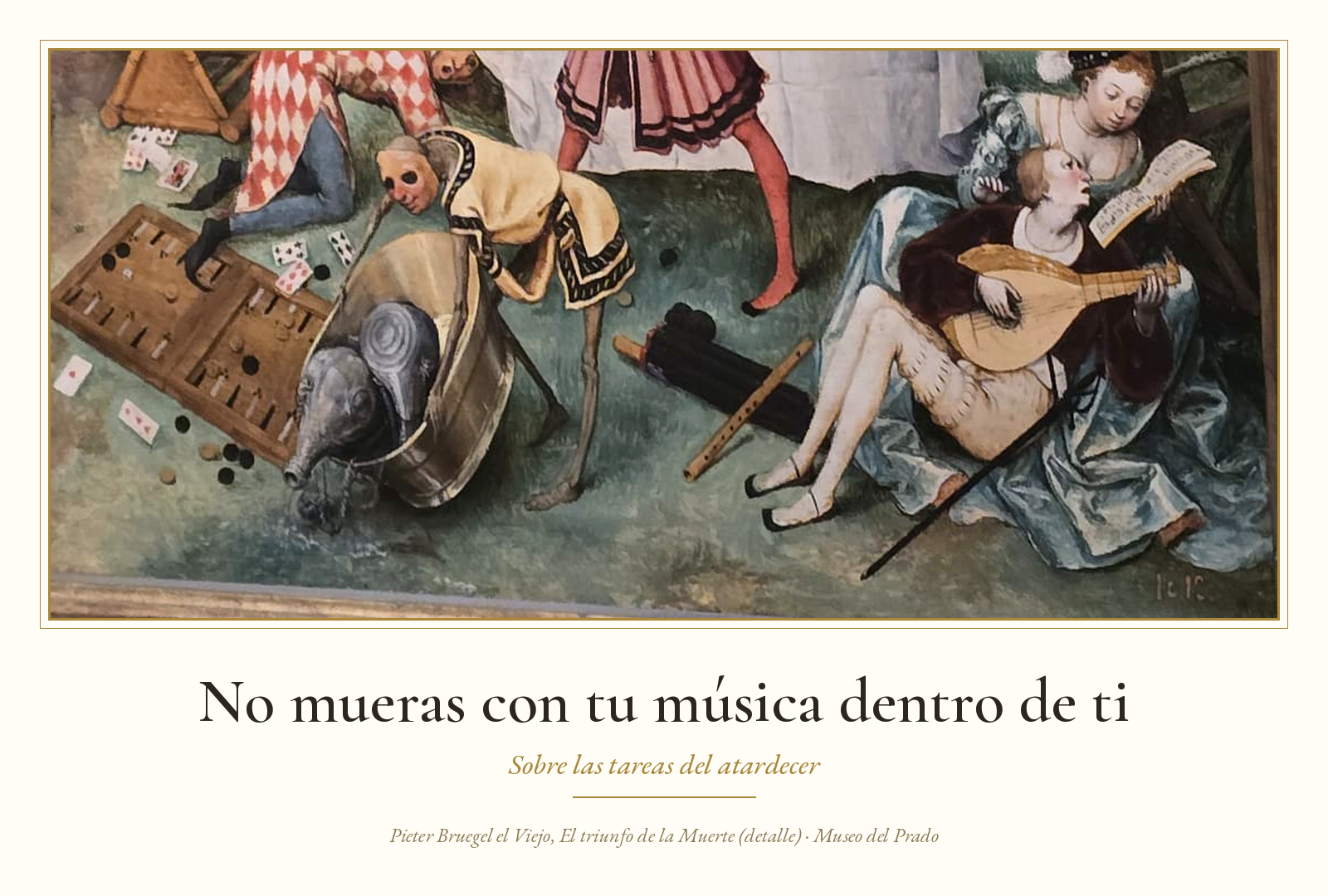
I stood for a long time before that devastation, taking in every detail. Then my gaze descended to the lower right-hand corner and found something I could not remember ever having seen. There, while the entire world burns and falls, a man plays the lute and a woman sings from an open score. His hands hold the melody; her voice lifts it; and between them lies the score: the music someone wrote so that others might sing it. Behind them, a skeleton has sat down and accompanies them on an instrument of his own. We might see them as the last oblivious souls in a doomed world, two lovers hiding in their small happiness while everything collapses; that is how their age judged them. But that morning I needed to understand them differently. I imagined that they had seen the skeleton, that they knew it was there, and that he went on playing and she went on singing all the same: not to defeat death, but to protect, for one instant, the small territory of humanity that love had opened between them. That was the corner the plague had not yet managed to occupy. Wisdom does not consist in ceasing to sing when we discover that we are going to die. It consists in learning to sing differently: in a voice more fully our own, and more transcendent.
Beside them, among the goblets, playing cards, and remains of the interrupted feast, I discovered a backgammon board. I had not gone looking for it; it had been waiting for me inside the painting like a secret signature. I love backgammon, and for years I have told my children that life is not a game of chess, solved by skill, intellect, coolness, and strategy; nor is it roulette, ruled entirely by chance. Life is like backgammon: chance and skill both count. Skill is essential, and chance plays its part, but the great player reveals himself above all in his ability to play a magnificent game even when the dice are against him. Anyone can play well with a generous roll. The true player is known when the bad dice come: by how he protects what he loves, how he turns waiting into position, how he remains at the table when fortune turns cruel. At sixty-three, one already knows something of one’s dice. I have been fortunate; I have received splendid rolls. I have also received cruel ones, and I know I will not choose those that remain. What I can still choose is how to play whatever comes.
That, I believe, is the wisdom the painting came to deliver on my birthday. In the evening of life, the questions change. James Hollis is a man I read for many years with the attention of someone who knows that reading can be therapeutic and transformative, long before I had today’s privilege of calling him my teacher, mentor, and friend, and of recently sharing an open conversation with him about these very questions. He has always spoken with the clarity of one who has accompanied thousands of souls through this crossing: the questions of the first half of life are asked by the world. They concern the development of the ego and the need to learn how to survive. How can I be accepted? What will I do to earn my bread? How can I belong? How can I “succeed”? And he adds something that recasts the role of ambition: “The role of ambition in the first half of life is to build an ego strong enough to undertake the difficult task of looking inward in the second.” For the questions of the second half are different. Who am I, really, beyond my roles and identities? What is asking to be lived through me? Who am I beyond my history? What do I have to give the world that only I can give? Or, in the language of the painting’s corner: What is the music that only I possess, and how much of it remains inside me? Let us remember the great admonition of that Transcendentalist genius Henry David Thoreau: “Don’t die with your music still inside you.” Perhaps that is the great task of an entire life, but it is unquestionably the leading one when afternoon has passed, evening approaches, and night announces the end of the day.
A great life requires the full development of both dimensions. An ego that was never built can scarcely be transcended. The error is not in having wanted to be important. The error would be to reach the end without discovering that being important and serving what is important are not the same thing.
At that crossing, I believe, the great struggle of every life is fought: the struggle between love and power. Jung captured it in a single line: where love rules, there is no will to power; where power predominates, love is lacking. Power requires some form of submission; love requires freedom. And beyond its visible costs, all power exacts a secret toll from the soul: inner freedom, silence, mornings of one’s own, time to love, think, and create. An age arrives when it is no longer enough to ask whether something is possible. We must ask whether the soul can afford it.
I have come to one great conviction in my life: no skill is more important to living greatly than learning how to suffer creatively. Suffering by itself does not ennoble us. It can make us cruel, resentful, or barren; it can shrink the world to the dimensions of our wound. To become wisdom, suffering requires work: we must descend into it and ask what illusion it has destroyed, what shadow it has revealed, what pride it demands that we sacrifice, what new form of consciousness is trying to be born. Just as we do not control the dice, we do not choose everything that happens to us. But we unquestionably have a say in how we respond and what we make of what has happened.
The English language, in which I also write, preserves this intuition in its roots. Happiness and happen share the old stem hap: chance, fortune, that which comes to pass. Etymology does not prove a philosophy, but it preserves a powerful image: happiness is born not from controlling existence, but from a fruitful encounter with what life brings us. We can be happy only within present reality: not when life finally submits to our plans, but when we learn to inhabit what is.
I would like to die suddenly and whole, without illness or a long Via Dolorosa. But if what I most fear should one day arrive, the slow decline that carries us away, surrender would still remain. Not bitter resignation, nor the glorification of pain, but the decision to stop spending what energy remains denying the irreversible, and to ask what work of the soul is still pending and still possible there: learning to receive after always wanting to provide; accepting a vulnerability the ego once considered beneath its dignity; transforming even dependence into a final experience of love. The great test of a philosophy is not whether it finds meaning in the life we chose. It is whether we can create meaning within the life that happens to us.
And for as long as life grants me lucidity and vitality, I have only two great tasks remaining if evening is to arrive with peace in my soul: rejoicing and transcendence. Properly understood, they are the two ways not to die with the music still inside us. Rejoicing is the music we play: the music of the day, of the instant, the music that cannot be stored for later. Transcendence is the music we write: the score others may sing when we are gone, the score only we could have written.
Rejoicing is, as Camus might say, stealing an hour from the plague. The plague is illness, but it is also tyranny, fear, exile, resentment, vulgarity, the endless machinery of the urgent. It seeks to occupy our conversations, our mornings, and our imagination; it insists that even joy must ask its permission. To steal an hour from it is not to deny the suffering of the world. It is to remember why it is worth resisting. And let no one confuse rejoicing with its counterfeits. It is not entertainment, which distracts us from living; nor is it pleasure, which is sought, consumed, and exhausted. Rejoicing is not sought; it is received. Pleasure consumes the instant; rejoicing consecrates it. It is grateful presence before what is still alive: a long table with children or friends, where conversation deepens and the masks fall; a meal prepared with one’s own hands; a bottle of wine opened with no justification beyond sharing it with those we love, because being alive is occasion enough. The embrace of a child, the meeting with the beloved, a city walked without haste, a body still capable of desire and tenderness, a free morning for visiting a museum, reading, and writing. None of these things is small; what is small is our capacity to see them. A great wine, drunk with gratitude, can be a minor and perfect form of prayer. That is the music of the day: if it is not played today, it will never be played.
Transcendence, for its part, does not mean preventing our name from being forgotten. It means delivering what life entrusted to us. There are works we write, and there are works that write us: they gather their materials silently over the years, feeding on our loves, ambitions, losses, and awakenings, until we understand that they do not belong entirely to us. The Religion of Genius is the book that now gathers and gives order, retrospectively, to the great lessons of my life. It is, without question, the fruit of my creative suffering. It is not merely an intellectual work; it is my legacy of love to my children, my grandchildren, and all who wish to undertake the work of the soul honestly: my attempt to transform experience into consciousness, suffering into wisdom, and biography into symbol. I hope it finds a publisher; if it does not, I will publish it myself, because there are works whose first duty is not to triumph but to exist. Here Thoreau’s warning returns, now transformed into a task: transcendence, rightly understood, means bringing forth all the music, the music only you can give the world, and sharing it before night falls. This book is my score: the form my love has found to travel farther than my body and my voice; my way of sitting one day, when I am gone, at my descendants’ table, not to govern them, but to accompany them, so that they may sing in their own voices what I managed to leave in writing. Perhaps dying in peace does not mean having finished everything. Perhaps it means not having betrayed what was essential.
I left the Prado in the afternoon light and returned home to finish this essay. Behind me, death continued to triumph in the painting, as it will continue to triumph when I am no longer there to contemplate it. But the lovers remained in their corner, he playing, she singing, the fallen board at their feet and the skeleton seated beside them, and the music continued. Not because it is more powerful than death, not because it will prevent death’s arrival, and not because love grants immunity. The music continues because death may end life, but it need not decide how life will be lived.
At sixty-three, death begins to resemble a severe editor. It strikes out superfluous pages, cuts away resentments, questions commitments, and forces us to discern which relationships deserve our time, which conversations must take place, which journeys must not be postponed, which work demands priority. In youth, we believe choosing means adding. In maturity, we understand that choosing means relinquishing. Knowing there will not be time for everything allows us to discover what the true everything was.
And so today I make a vow: to love deeply and without postponement; to give thanks every day; to remain close to those I love; not to squander myself on the trivial and the foolish; to care for the body that still carries me; to play with artistry whatever dice may come; and to finish the book I came to write, so that I do not die with the music still inside me. I do not promise myself that I will defeat death. I promise not to surrender to it, ahead of time, the life that still belongs to me.
And when death finally comes, whether in the clean form I desire or the difficult form I fear, I would like it to find me loving, in profound gratitude, with my work delivered and my music in the world for you to enjoy.
May it find me with my stories and my dead behind me, and my children ahead.
May it find me at the table, still awake, raising a glass of good red wine to life.
May it find me inhabiting, like the lovers in the corner, the small space the plague could not occupy.
The age at which the men of my blood began to lay down their instruments will be, for me, the age at which I finish tuning mine. So that death, as with the lovers, may find me having written my music and sung my song.
In the meantime, I leave you: I must get ready to welcome my friends, with whom I plan to toast, celebrate, sing, and steal the whole night from the plague!
Originally published on Substack on 26 July 2026. View the original.