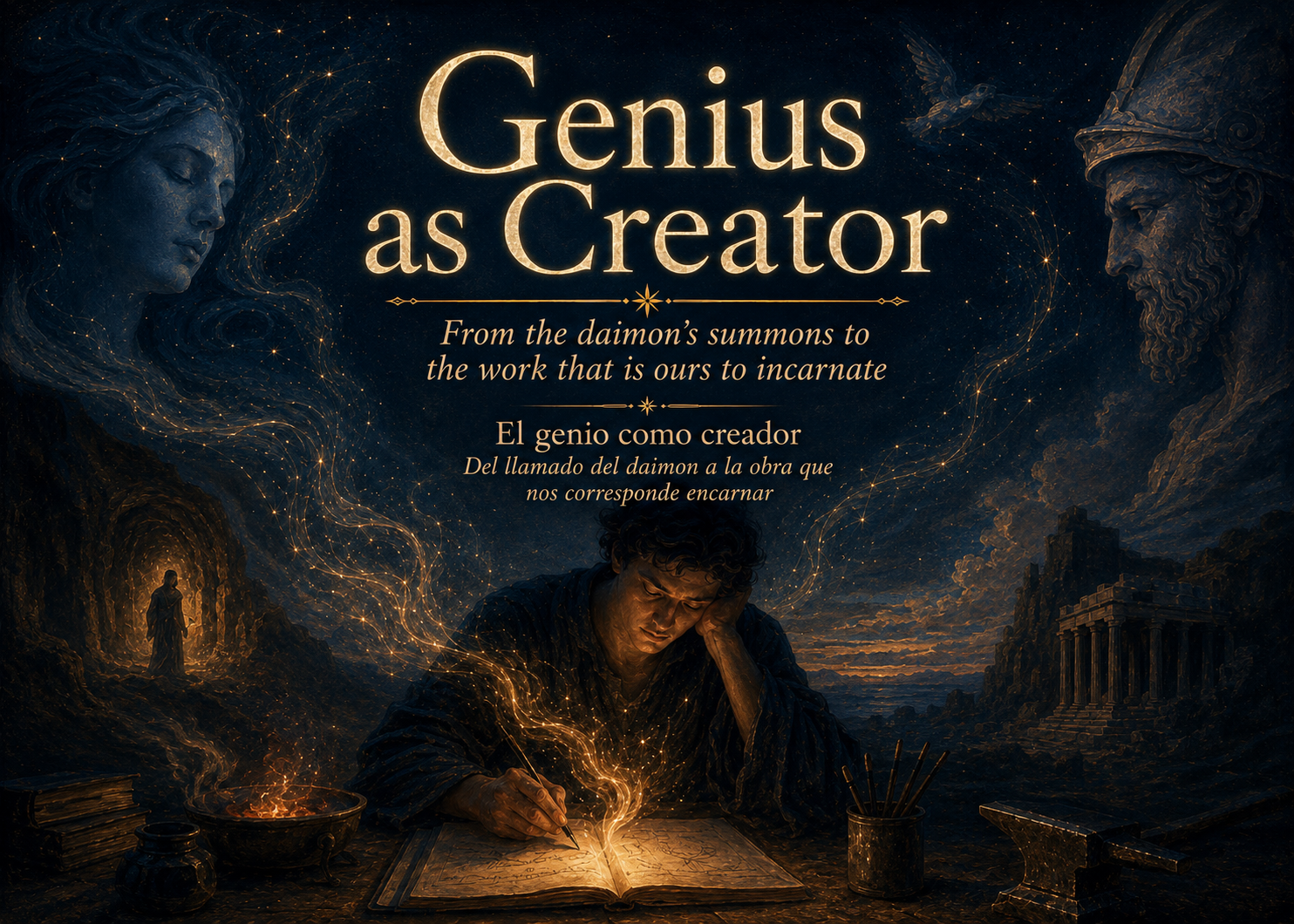
Genius as Creator
From the daimon's summons to the work that is ours to incarnate
“Creativity is neither the product of neurosis nor simple talent, but an intense courageous encounter with the Gods.”
— Rollo May, The Courage to Create
There is something extraordinary in that sentence of Rollo May’s. To truly create is, in some way, to enter the territory of the gods. I don’t necessarily mean God in the conventional religious sense. I mean something far older and, to me, far more interesting: the human being is a creature that can bring into the world something that did not exist before. A song, a painting, a company, a theory, a new way of raising a child, a life that was written in none of the manuals we were handed. We create. And in that act there is something that has always struck us as nearly divine.
May also understood something essential: that creation requires courage precisely because the creative encounter is not harmless. It moves the ground beneath us. It puts us face to face with our anxiety, our limitations, our uncertainty and, often, with parts of ourselves we had managed to keep perfectly hidden. The creator is not necessarily the one with the least fear, but the one willing to stay there long enough for a form to emerge out of the fear, the chaos, and the unknown. To create is not to decorate a life. It is to risk bringing something into existence.
And perhaps that is why a sentence Carl Gustav Jung wrote almost in passing, sixteen months before his death, strikes me as so extraordinary.
In February 1960, Jung answered a letter from A. D. Cornell, a British researcher of the paranormal who wanted to know where certain psychic phenomena came from. Jung explains that such experiences tend to occur when the threshold separating ordinary consciousness from the collective unconscious becomes unusually thin. The medium lives near that threshold, as do certain psychologically fragile people. And then Jung adds:
“People with creative genius also belong to this type.”
Read that slowly, and let’s try to take its full measure. Jung is not flattering artists. He is proposing something genuinely radical: that the medium, the psychologically overwhelmed person, and the creative genius all inhabit the same border region, that territory where ordinary consciousness becomes permeable to something deeper. They are not the same, nor are their experiences identical, but they live near the same psychic fault line. What matters is what happens after the crossing. One person is flooded by what arrives; another merely transmits it; another manages to contain it long enough to give it form and turn it into a work. That is creation. The decisive faculty is not simply openness, but what we are able to do with whatever comes through the opening.
Here I need to distinguish between what Jung means by “creative genius” and what I propose in The Religion of Genius. Jung is speaking in the conventional sense of exceptional creators: the extraordinary artist, the uncommon mind. My wager is more radical. I believe the daimon is no one’s privilege. It speaks in each of us and, more than that, it has never stopped. The call does not belong to an elite of the chosen. What is a possibility, and never a guarantee, is genius: our capacity to hear that call, discern it, incarnate it, and turn it into work.
That changes a great deal. I am not saying we are all Shakespeares or Mozarts waiting to be dusted off. I am saying something far more demanding: that all of us are called, but not all of us answer. The possibility of genius belongs to everyone; realizing it demands a discipline, a courage, and a willingness to bear suffering that very few are truly prepared to assume. The call may be universal. What is exceptional is sustaining it for years, even decades, until it finds a form in the world.
Every culture that took the sacred seriously intuited something like this long before psychology invented a vocabulary to explain it. The Greeks did not imagine the poet as a small private factory of poems. Poetry was one of the four divine madnesses, attributed to the Muses, who possessed the poet and spoke through him. Socrates spoke of his daimon, that strange inner presence that intervened at the decisive moments of his life. The ancient imagination knew something we have largely forgotten: the creator participates in creation without necessarily being its ultimate source.
Modernity slowly turned the gift into property. Now we speak of my talent, my creativity, my genius, as if inspiration were private capital lodged somewhere inside the skull, waiting to be optimized, monetized, and turned into a brand. But an antenna does not own the signal. It receives it.
Ask a writer about that rare morning when a sentence arrives before thought could have produced it. Ask a composer where the melody was five seconds before it appeared. Ask a scientist why the solution sometimes surfaces in the shower after three days of failed calculations. The honest answer is usually far less impressive than our theories of genius: I don’t know. It came to me.
I can testify to this in the first person singular. There is no more creative space for me than that strange morning threshold between sleep and waking. There, whoever it is that arrives arrives, and gives me the cue. Then I sit down to work and, from where I cannot imagine, ideas begin to appear that I did not have minutes earlier and that I experience, unmistakably, as having come to me. I don’t need to know exactly where they come from to recognize the experience. There are moments when you do not feel you are inventing; you feel you are receiving.
Harold Bloom becomes an unlikely witness here. He could hardly be called a Jungian, and yet in his monumental Genius, every time he tries to approach the mystery of creative originality, the daimon reappears. So does that inner God, that strange second presence that seems to know more than the conscious writer knows. Bloom returns again and again to Emerson, who wrote in 1831: “It is God in you that responds to God without.”
There is something astonishingly precise in that sentence. Why can a poem written centuries ago strike us not as new information but as recognition? Why can someone we have never met articulate on a page something we had been carrying wordlessly for half a life? Perhaps reception does not happen only in the creator. Something reaches the artist; the artist gives it form; that form reaches another person; and something in that second person recognizes itself. Genius cannot be reduced to intelligence, productivity, or technical mastery. All of that matters. But none of it fully explains that peculiar energy by which one soul awakens another.
The antenna still seems to me a good metaphor, but only a metaphor. An antenna points upward, while Jung’s psychology often points down. What emerges in a creative state may not descend from some transmitter beyond the stars. It may rise from a depth so remote beneath the conscious self that we experience it as coming from somewhere else. The unconscious is not another planet. It is the unexplored territory of our own house, and sometimes inspiration sounds like footsteps coming up the stairs.
And yet I feel no need to decide that everything lies below, in the unconscious. I dare to think that the intelligence of the universe, of the whole, of the divine, if it exists in the way we intuit it, is neither above nor below. It is not in one place and is, somehow, in all of them. Where is your phone’s signal right now? To your right or your left? Above you or below? The question begins to sound absurd when the thing we are trying to locate passes through us from every side.
Whether those footsteps belong only to the psyche, or whether the psyche itself opens onto something greater, is a question I have no desire to close prematurely. Mystery deserves more dignity than certainty.
If genius involves reception, then serious creation requires a temporary loosening of the ego’s ordinary control. Jung used the expression abaissement du niveau mental, a lowering of the mental level. This does not mean becoming less intelligent, or confused. Think instead of the tide going out and revealing a shoreline that was there all along. The usual guardians of consciousness relax, the wall grows thinner, and what ordinarily stays beneath the surface begins to become accessible.
I still remember a class I took at Stanford: Creativity in Business, taught by that marvelous genius Michael Ray. I thought I was signing up for a class that would teach me business ideas, some brilliant methodology for being more creative and, ultimately, making money. When I arrived, I found a wise man who sat us on cushions on the floor, put on Indian music, a tamboura, I think it was called, and taught us to meditate. To get out of the way so the creative could appear.
The irony has always delighted me. Michael was considered something of a creativity guru in Silicon Valley, and I remember a Fast Company cover calling him “the most creative man in the most creative valley.” And it turns out the most creative man in the most creative valley was not teaching us to produce more ideas, but to obstruct less.
Many years later I understood that what Michael was teaching us intuitively had an extraordinary correlate in the work of Mihaly Csikszentmihalyi. He called Flow that state in which we are so deeply absorbed in an activity that self-consciousness recedes, time changes shape, and the voice that watches us from outside, asking how we’re doing, what people will think, who will get the credit, temporarily disappears. The self does not vanish. What vanishes, for a while, is our obsession with the self.
This matters to me because I am not proposing the destruction of the ego. We need a strong ego to discern, organize, edit, persevere, set limits, and finish a work. The trouble begins when that ego believes it must also direct the mystery. Flow occurs precisely when a person of sufficient capacity gives themselves entirely to a task that demands them fully. It is not passivity. It is not sitting around waiting for the Muse to do the work. There is craft, concentration, training, and surrender; but there is also a momentary form of self-transcendence. For a while, you stop asking who you are and simply flow.
Anyone who has created seriously knows what I am talking about. Time behaves differently. Attention changes texture. A book refuses to obey the outline, a character starts saying things the author never planned, a painting suddenly demands the wrong color and the wrong color turns out to be exactly right. For a few minutes, perhaps a few hours, you stop feeling entirely like the author and become, instead, a collaborator in something that is happening.
Goethe understood this extraordinarily well. He said that the highest creative discoveries were not entirely within his control; they arrived as gifts, and the creator became, for an instant, a vessel capable of receiving a greater influence. But Goethe also understood what Romanticism tends to forget: after the gift comes the work. The vision may arrive in seconds; the opus may demand twenty years.
That distinction is everything. Inspiration is not craft, and craft is not inspiration. One receives; the other incarnates. The true discipline of genius does not consist, therefore, in maximum openness, but in something I have long been thinking of as disciplined permeability: staying open enough to hear without opening so wide that you are swept away by everything that comes.
The daimon speaks to everyone, but obeying it usually hurts. It may ask you to abandon securities, to disappoint expectations, to endure long stretches in which no one understands what you are doing, to work without recognition, to fail, begin again, and remain faithful to a work that may never repay you the way you imagined. Rollo May insisted on precisely this: true creativity lives alongside anxiety, insecurity, sensitivity, and exposure. The creator does not eliminate these things. He learns to work through them.
That is why the possibility belongs to everyone but the realization belongs to far fewer. Not because God handed out daimons only to a chosen few, but because hearing is not enough. You have to bear what you have heard. You have to work. You have to pay the price.
For a long time I thought about this process mainly through Dionysus and Apollo. Dionysus opens, moves, breaks rigidity, returns us to emotion, to the body, to the intensity of being alive. Apollo differentiates, illuminates, gives measure and form. But lately a third god has begun to interest me: Hephaestus. Because someone has to go to the forge.
Hephaestus is the great craftsman of Olympus. He knows the wound, the rejection, the humiliation, the fall; but he does not sit contemplating his suffering as if suffering were itself a work. He takes it to the workshop. He lights the fire. He strikes the metal. He works. The image interests me more and more, because perhaps the creative arc needs all three. Dionysus hands us the living, overflowing experience; Apollo lets us see it, differentiate it, understand it; Hephaestus works it until it takes on a body. Suffering does not create on its own. It has to pass through the forge.
The daimon summons; the genius creates.
The daimon rarely arrives with good manners or any respect for the calendar we had prepared. It can appear as anxiety in the middle of success, as an obsession with no apparent use, as a recurring dream, an inexplicable attraction, or a project that refuses to die no matter how many years we spend explaining to it, rationally, why it should. Suddenly a distance opens between the life you are living and the life asking to be lived; between the successful person you have built and a soul that feels abandoned; between belonging and being true. The old life begins to feel uncomfortable, sometimes even unlivable, before the new one has come into view.
There is an old and disputed etymology that hears in religion the Latin religare: to bind again, to reconnect. I don’t need to settle the philological dispute here; what interests me is the image. The daimon cracks the shell of a life that has grown too small. Genius is our capacity to take what the rupture reveals and give it a form capable of existing in the world.
That is the religious work that interests me. Not obeying a creed, but binding back together what modern life has torn apart: ego and soul, the visible and the invisible, the life we perform and the life that calls us from below.
Reconnect with what? First of all, with ourselves. Learning to hear our own soul may be one of the most important skills we can develop, because only from there can we recognize the daimon and live in congruence with the singular call of our being. But the reconnection does not end there. When we begin to recover an authentic relationship with ourselves, something also changes in our relationship with the Other, with the collective, with the planet, with the cosmos and, finally, with whatever each of us may call God, Tao, totality, or the sacred. Different languages for approaching the mystery of belonging to something greater than the ego.
I cannot prove that the voice rising beneath the ego comes from God. I cannot prove that the Muse exists, or that the daimon has an independent metaphysical reality. Nor does it seem to me that materialism can close the question simply by pronouncing the word “neurons.” Here I prefer uncertainty to reduction.
What fascinates me is that something happens at the outer edges of creativity that pushes even very different people, again and again, toward that threshold. Bloom keeps finding the daimon. Jung speaks of the numinous and the collective unconscious. Michael Ray was literally teaching us to get out of the way. Csikszentmihalyi observes that in our deepest states of absorption, the preoccupation with the self withdraws. Rollo May speaks of a courageous encounter with the gods. They are not saying exactly the same thing, and I am glad they are not. I don’t need to fit them all inside the same church. It is enough for me to observe that, by very different roads, they keep arriving at a similar frontier.
None of this means that every inner voice is sacred. Some voices are wounds. Others are fear, complexes, resentment, or plain grandiosity in ceremonial robes. That is precisely why permeability needs discipline. We have to learn to listen without becoming credulous. But there is an opposite superstition that seems to me equally impoverishing: believing that whatever cannot be fully measured must therefore be meaningless.
Perhaps that is why the emptiness inhabiting so many outwardly successful lives deserves far more attention than we give it. The hollow behind the résumé, the strange silence after the promotion, the sadness that appears when we finally obtain everything we were told to want. These are not always pathology. Sometimes they are signs of disconnection. Somewhere along the ascent, the signal began to interfere with the map we had been handed, and we learned to silence it. But the call did not disappear. The daimon kept speaking. We became harder to reach.
The incarnation of genius is not, therefore, acquiring something you lack. It is closer to a reconciliation. You do not magically become someone else; you remove, piece by piece, whatever keeps you from hearing what may have been speaking to you all along. You cultivate solitude, you bear silence, you pay attention to recurring images and desires, you sharpen the tools of your craft, and you return, again and again, to the work. When something arrives, you do not dismiss it, but you do not kneel before it either. You work it, even when it hurts, because that is the decisive difference between hearing the daimon and realizing the genius. All of us can be reached. Very many of us are reached. What is rare is remaining faithful once we discover what the thing that calls us actually asks.
Because the divine, if divine it is, does not type. The Muse does not proofread. The daimon does not finish the manuscript. What arrives as image must become a poem; what arrives as intuition must take on form; what arrives as vocation must finally become a life. That is the pact every creator ends up discovering: to be porous without dissolving, receptive without becoming credulous, disciplined without becoming sterile. To let something arrive, and then to have the strength, the patience, and the courage to carry it into the world.
Perhaps that is what Jung glimpsed when he wrote those few extraordinary words: “People with creative genius also belong to this type.”
The daimon speaks to everyone. Genius is the possibility of answering with a life.
The question, then, is no longer whether you are called. It is whether you will pay the price of answering.
Originally published on Substack on 23 August 2026. View the original.