Sicily and Us
Transcendent Palimpsests
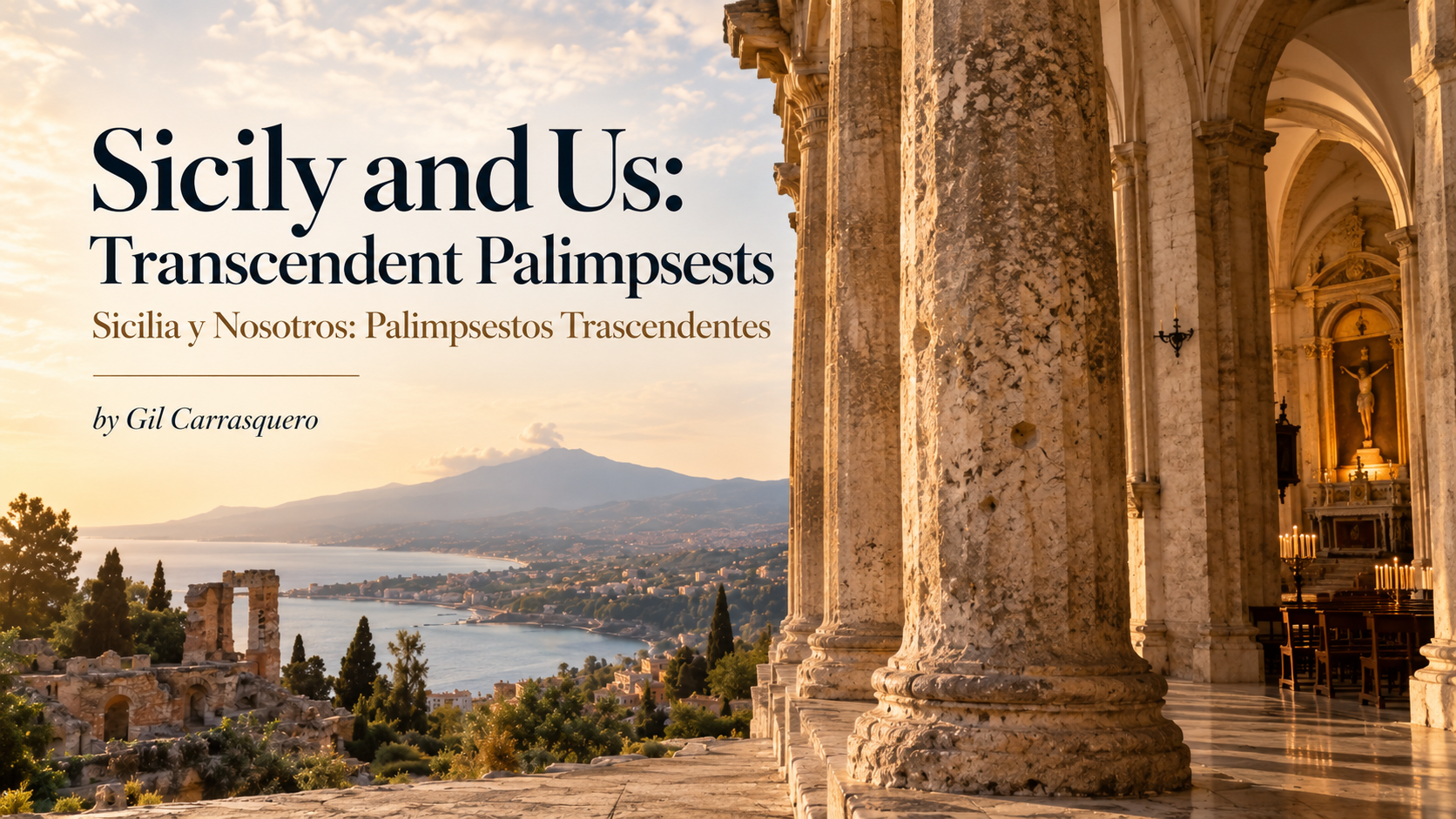
As I sit down to write these lines, I am about to finish two of the most extraordinary and enriching weeks of my life. I came to Sicily for no other reason than a wedding, the daughter of very dear friends, and decided to make the most of the occasion and see the island, never suspecting that the invitation would open the door to one of the great cultural treasures I have had the good fortune to discover.
From Taormina to Palermo, by way of Syracuse and its island of Ortygia, Noto, Ragusa and the Valley of the Temples at Agrigento, I have travelled through a Sicily whose richness I am still trying to absorb. These days, without my intending it, have been a pilgrimage. The guides I carried with me, written to help me understand what was in front of me through its history, its art and its mythology, took me beyond astonishment: they let me recognize, beneath the visible beauty, the stories that had made it possible. Each place gained depth; each discovery cast light on something I had seen before.
Somewhere along the way a word appeared that I had not known until then: palimpsest. I believe it is the most lasting gift I am bringing home from Sicily. Among so many temples, mosaics, cities and landscapes, that word gave me an image capable of gathering the whole journey into itself. An image that began by helping me understand the island and that now, as I sit down to write, invites me to a reflection, and to a way of looking at life itself.
A palimpsest is a manuscript, usually parchment, whose writing was erased so that something else could be written over it. The surface was washed, the words scraped away, the skin made ready to receive a new story. But the procedure left traces: beneath the fresh ink another writing remained which, under the right light and with enough patience, could be read again.
That is how part of the work of Archimedes survived. In the thirteenth century a scribe reused the parchment of several old codices to make a prayer book: he scraped their pages and bound them together beneath the prayers. Among those leaves were treatises of Archimedes believed lost, two speeches by Hyperides, a commentary on Aristotle. In 1906 the philologist Johan Ludvig Heiberg read the Archimedes; the other leaves had to wait nearly another century, until a light the eye cannot see made it possible to read what the prayers had covered. The geometry had waited almost seven hundred years beneath the liturgy, and it had not waited alone: the prayer book was, without knowing it, a library.
Archimedes was from Syracuse. It is worth remembering, because that is where I first met the word, an audio guide in my ear, looking at the columns of the temple of Athena that today hold up the Cathedral of Syracuse and are perfectly integrated into it.
There are words we learn in order to name a thing and end up needing in order to understand our lives. Palimpsest is one of them.
As we travel through Sicily we begin to suspect that the whole island is written that way. The parchment became stone, the sentences temples, the alphabets cities. Greeks over Sicels, Romans over Greeks, Byzantines, Arabs, Normans, Spaniards: each age works on the body of the one before, and none manages to erase it entirely. But the island did not always treat its dead in the same way. There are places where it scraped, and what was scraped came back on its own, as everything badly erased comes back. And there are places where it scraped nothing, where it built around what was already there and left the difference in plain sight. We will go on being palimpsests whatever we do; what is decided at every layer is whether we scrape again or learn to read. Between those two ways of treating the past the fate of an island is played out. So is the fate of a life.
To look for a pure Sicily, prior to all its transformations, would be to begin stripping it of what makes it not only intricately beautiful but unique. How many stones would have to be removed before we found an identity that owed nothing to anyone? By the end of that imaginary cleansing there would be no island left to love.
In Ortygia the question takes on a body.
We enter the Cathedral of Syracuse after taking in its baroque façade. The eye needs a moment to recognize what it is looking at: those great Doric columns embedded in the walls belonged to the temple of Athena. The ancient sanctuary is not merely underneath the church, waiting for an excavation. It is part of it. The builders walled up the spaces between the columns, cut arches through the walls of the cella, and turned the temple into a church without tearing it down. No one scraped Athena away. They left her standing, holding up the roof of another god.
Let us stop before one of those columns.
The goddess ceased to receive worship. Her columns did not cease to be necessary.
The stone was carved to house a presence and ended up taking part in another conception of the sacred. The prayers changed, the names, the ceremonies; part of the body remained. Athena is not Mary, and religions are not interchangeable costumes. That is precisely why the image moves us: two worlds that do not mean the same thing can hold up a single roof, and the building need not lie about either of them. The history that produced that superimposition was no reconciliation without losses; no later beauty gives back what was destroyed. But the column is there, and in its persistence we recognize something that exceeds the intentions of its builders: a way of remaining without staying the same.
In Taormina even what is missing takes part in the revelation. The great Roman stage wall once closed off much of the view that dazzles us today. Its ruin opened the theatre onto the landscape. Where a wall once stood, Etna now appears. Time knocked down part of the scenery and let the mountain in.
Time turned out to be the set designer.
Not every destruction opens a horizon. But sometimes we discover, long afterwards, that the horizon could only appear thanks to the gap left by what we lost.
In Palermo the convergence of cultures that makes Sicily what it is reaches its highest point in the Palatine Chapel, where, by order of Roger II, a chapel was built in which Byzantine mosaic revels in light to create Christian images that mingle with a marvelous wooden ceiling in the Islamic artistic tradition. It is astonishing: there the cultures are not merely superimposed. They coexist, they get along, they converse, in a harmony that transcends them without erasing their differences.
And then Sicily stops being a place we travel through. It becomes a question that travels through us.
Because we too have been written many times, and not by a single hand.
We like to tell our lives as a single story, with a protagonist who was always us and a plot that moves forward. But it takes only an honest look to discover that we are more like a volume bound from the leaves of several books. There is a story written by the child who needed to be chosen, another by the young man who promised to conquer the world, another by the one who loved someone believing it would last forever, another by the one who chose a profession the way one chooses a name. Each has its own narrator, and each narrator remains convinced that the story is his. The child goes on waiting inside the admired adult. The young man may look with contempt at the man who learned to live without conquering it. In an argument we recognize our father's voice; in an unexpected tenderness, a gesture of our mother's. A love that ended goes on taking part in the way we approach another body.
Sometimes life changes the light on us and we see, beneath the sentence we thought was ours, the handwriting of someone we used to be.
Beneath the cathedral we now call “I” stand the columns of the temples we once inhabited.
I once heard, in a one-man play, a line the character attributed to Ortega y Gasset: “We are nothing but the ruins of the man we once dreamed of being.” I have never found it in his work; I keep it for what it is, a remembered phrase. What Ortega did write, in History as a System, resonates with it: “Man has no nature; what he has is… history.” We are not a finished thing, separable from what we have lived. And among our stories are also the ones we never got to live: the vocation that gave way to security, the city where we imagined growing old, the book that for years had a title and never a first page. There are ruins of what was lived and ruins of what was possible. Some barely hurt; others rise inside us with the majesty of an unfinished temple, and we do not know whether to finish them, to take our leave of them, or to remain kneeling before the life that never was.
And yet Sicily makes me argue with the first words of that sentence. Are we really nothing but ruins? A column carved for a temple can take part in a building its architects never imagined. The failure of an identity does not exhaust the possibilities of a person. We are not only our ruins. We are also the ones who can answer for what gets built with them.
I too have mistaken a decision for a farewell.
As a young man I was seduced by power. I wanted a place of my own in politics. Over the years, my intellectual and psychological journey transformed that ambition: I moved away from politics but remained deeply engaged with the political, through thought, analysis and public intervention. More recently, as I concentrated on my book and my essays, I wanted to close that door as well. I promised myself, with absolute firmness, that I would never again speak publicly about politics. My voice would be devoted to philosophical and psychological matters. I believed it.
Until an event connected with Venezuela stirred in me an indignation so intense that I ended up appearing on two television programs the same day. The man who had decided to keep silent was speaking out again.
Perhaps the task was never to expel that history from me, but to find it a different place in the way I think and write.
I remember a phrase of Rafael López-Pedraza, my old teacher, delivered with the bluntness of his Caribbean speech: El que machetea su historia la hace sombra.
A machete is the long, broad blade of the Latin American countryside, the tool for clearing brush, cutting cane, opening a path through whatever stands in the way. To machetear is to hack: not to prune, not to dig anything up, but to swing at what blocks the view until it falls. And what falls under a machete is never the root; the root stays, and grows back in the dark. So the phrase says something like this: whoever hacks his own history away turns it into shadow. Sombra here is Jung’s shadow, the part of ourselves that goes on living precisely because we refuse to look at it. The word matters. To hack is not to understand, nor to work through, nor to say goodbye. It is to cut down what is in the way so as not to have to keep seeing it. “That meant nothing.” “I was never really that person.” “I don’t talk about that anymore.” I said the third one. We can repeat those sentences until they sound like a farewell, while underneath, the conversation we are avoiding remains intact. There is an enormous difference between leaving a house and declaring that we never lived in it. We can end a love without turning into a lie every day on which it was true. We can leave a profession without despising the person who chose it.
Jung wrote in Aion: “When an inner situation is not made conscious, it happens outside, as fate.” He said it of the man who fails to become conscious of his inner opposite, so that the world ends up acting out the conflict in his place. There is no need to turn this into a magical law; the world has its own violence and its own chance. But the warning admits an intimate reading: the erased writing goes on interfering with the sentence we are trying to write. I tried to write “silence” over a page that said something else, and the page read itself aloud on television.
And what comes back from below is not always shameful. Marie-Louise von Franz reminded us, in Man and His Symbols, that the shadow is not necessarily an adversary, that it turns hostile only when it is ignored, and that everything the ego does not know gets mixed into it, including its most valuable forces. We buried a tenderness because it looked like weakness, an imagination because it produced no income, a joy because at home seriousness was mistaken for sadness. And in renouncing an outsized ambition, we threw away with it the vocation that had grown up tangled with the ambition. Not everything that demands attention from below wants to return us to a prison. Something may be asking for a more mature form of existence.
Over the door of Jung’s house in Küsnacht there is an inscription: Vocatus atque non vocatus deus aderit. Called or not called, the god will be present. Before the temples of Sicily the sentence widens and speaks in the plural: invoked or not, the gods make themselves present.
We may imagine we have closed their sanctuaries and discover later that something of our life still gathers there. To listen to those presences is not to obey them. The work consists in recognizing what they embodied, which part of their power we must limit, and which part may yet find a fruitful form.
That is why to integrate is not to repeat.
Athena’s column does not need to recover its old cult in order to go on taking part in the life of the building. A love may have ended and keep its place in our capacity to give ourselves. A profession may be left behind and still hold up the work that is only beginning. A dream may lose its literal form and reveal, at last, the desire that animated it. The greatness we pursued as recognition may find a quieter form in the quality of our attention. Something dies. Something can be transformed. Telling the two apart takes patience, and no one does it by decree.
There are ruins others left inside us and ruins we left in someone’s life. To integrate means reading both without turning understanding into absolution: sometimes it asks for an apology, sometimes for repair, sometimes for accepting that we can no longer repair and that this impossibility also binds us. The task is a truer relationship with what happened, one in which the pain can be acknowledged without becoming our only name.
It is not enough to accumulate years and experience; we have to work them through. We can guard a wound for decades without having changed the way we inhabit it. Inner archaeology makes sense when it serves to enrich the life that is still happening. Reading an old inscription should let us write more freely, not condemn us to annotate it forever. Integration begins to show in something small: a response that no longer has to be the usual one, a silence that does not punish, a goodbye that does not humiliate, the permission to take up a vocation again without demanding that it repair our whole life.
Jung gave the name transcendent function to what happens when consciousness and the unconscious, instead of defeating each other, hold their tension until a new attitude appears that neither of them contained. The Cathedral of Syracuse is that, in limestone. It is neither Athena nor Mary; it is the building that houses them both without confusing them. This is what it means to call ourselves transcendent palimpsests: not because we are going to escape time, or reach some final version of ourselves free of contradictions, but because the meaning of a story is not sealed by its first writing. What was shame can open into understanding; what seemed only loss can teach a different fidelity. We remain palimpsests. What changes is that we learn to read ourselves, and a life that has been read can become larger than the wound it contains, and larger, too, than the vow with which it tried to close that wound.
Let us go back to the column. Its ancient stone takes part in a space that does not coincide with the one it was carved for. Nothing pretends to belong to the same century. The difference is still there, and the church is no less a church for it: it is truer. Perhaps that is the beauty we have come looking for: a life in which transformation need not be ashamed of its materials.
Reading these lines, you may have remembered a part of your story you still don’t know how to go back to. There is something you swore never to speak of again, someone you declared finished, an age of your life you only revisit with cruelty, a desire you pronounced dead with a firmness that seemed like maturity at the time.
We sometimes mistake the firmness with which we pronounce a farewell for the depth with which we have worked it through.
Go to it without the machete. You don’t have to give it back its old power, or promise to finish what it left unfinished. Nor do you have to pretend that column isn’t there. Read it. Acknowledge that there was life there, that the life was yours, and that you still don’t know what form it deserves in the house you are still building. That not-knowing may be more honest than any vow.
You are, like the prayer book that hid Archimedes, a volume bound from the leaves of many books. Some pages were forced on you; others you wrote with enthusiasm; some you regret; in several you recognize a hand that is no longer yours. No honest reading gives you back a blank page. But under the right light they can all be read, and read together they say something none of them said alone.
It is the only book you have.
You don’t have to tear out its pages for it to be yours.
The island does not ask you to become who you were again. It shows you an ancient column holding up a new form, and it leaves you standing before it for as long as it takes.
Originally published on Substack on 20 September 2026. View the original.