The Book that cost a life
Why am I here? Talking to you...
I want to tell you how this newsletter came to be. Not the professional version — the real one.
For most of my adult life, I was a highly motivated, ambitious man — absolutely certain he held his destiny in his own hands. Law school in Caracas. A master’s in political science. A Fulbright scholarship to Stanford for an MBA. Years in investment banking, then politics — including participation in an attempt to remove Hugo Chávez from power in 2002. A master’s in public administration at Harvard. A marriage to the woman I loved completely, and three children who completed what looked, from the outside, like a perfect life.
I had built something real. Something significant by every external measure.
And then, over a period of years, I lost most of it.
The financial security went first — wiped out in the emerging markets crisis of 1997. The political project ended in exile. And then, in the winter of 2003, my marriage entered a profound crisis. My wife asked me to leave — not just our home, but our shared dream. I remember driving north that afternoon, a single piece of luggage in the trunk, not stopping until I was somewhere in North Carolina. I cried the entire way. The darkest hours of my life were spent in a borrowed apartment in New York City.
Those losses — financial, political, personal — were the beginning of something I could not yet name.
A year or so later, I found myself in Caracas sitting across from a man named Rafael López-Pedraza — one of the most original Jungian analysts of the last century. I had not gone to him for therapy. I had gone with a grand proposal: a Jungian Center for Leadership Development that would save Venezuela’s — and the world’s — political class from its own psychopathology. After all, the world was a broken place and what it needed were leaders capable of embodying healthier values, of evoking in others new levels of consciousness.
He listened to my pitch. Then he asked me a question I have never forgotten.
“Do you know what a projection is? Can you tell me what is the projection of a man who sees the world as a screwed up place, who sees leaders as psychopathic and egocentric, and who believes the world needs to be saved?”
It took me no time to answer. The screwed up, psychopathic, egocentric man — was me. It was my world that needed saving.
He laughed. Then I said: “When do we start?”
We just did.
Eleven years of analysis followed. In that time, something shifted that no career, no coup, no business success had ever touched: I began to understand who I actually was — beneath the ambitions, the losses, the personas I had built and shed over the years.
During those same years, I deepened my engagement with the traditions that had quietly been shaping me since Stanford, where a remarkable professor named Michael Ray had first introduced me to meditation, inner silence, and the idea that wisdom is not acquired but accessed. The Tao Te Ching — which I had carried since my thirties as my spiritual bedrock — took on new dimensions. Buddhism, the Bhagavad Gita, and eventually the full corpus of Jung, Nietzsche, Hillman, Hollis, and Michael Meade — these were not academic interests. They were survival tools.
All of this accumulated. For years, in the back of my mind, there was a book. It kept changing shape as I changed. It wasn’t ready. Neither was I.
The book began taking shape in exile. Exile, I discovered, is a strange gift: it frees you from the expectations of the society that formed you, and forces you into an encounter with yourself that comfort would never have permitted. Solitude — real solitude, the kind born from losing everything familiar — is the breeding ground of self-knowledge. Ideas surfaced. A personal credo was being built not at a desk but through living — in the way I was trying to raise my children, in the way I was navigating foreign terrain, in the gap between what I had planned and what life kept insisting on instead.
For years, my daughter Marian was my witness. She would hear me talk about the book and answer with the affectionate impatience that only a daughter can deliver. “You keep talking about that book, papá, and it still doesn’t exist.” At some point she said flatly: “I don’t believe you anymore.” But the book kept writing itself — in fragments, in essays, in late nights — until a structure finally emerged.
Then, in 2025, a painful end to a relationship I had deeply invested in forced me to practice what I had been preaching. To meet loss not with escape but with creation. I devoted myself fully to the manuscript. I was planning a writing retreat in Italy when a conversation with Murray Stein changed everything and led me to Eranos instead.
Eranos is the legendary gathering place on the edge of Lake Maggiore in Switzerland where Jung, Kerenyi, and Hillman once exchanged ideas about the nature of the soul. I arrived as a Scholar in Residence, carrying a manuscript that was close but not yet complete. I knew what the book was about. I did not yet have the language for the precise thing it needed to say.
One afternoon I pulled a small, obscure German text from a library shelf. Thomas Ring. Genius und Dämon. I opened it without expectation.
By the time I closed it, I had the hinge. The distinction between the Daimon — the universal inner summons, the voice that calls each of us toward our particular life — and Genius — the costly, irreplaceable act of incarnating that summons in the world.
Eranos was not where the book became real. It was where years of creative suffering finally found their form.
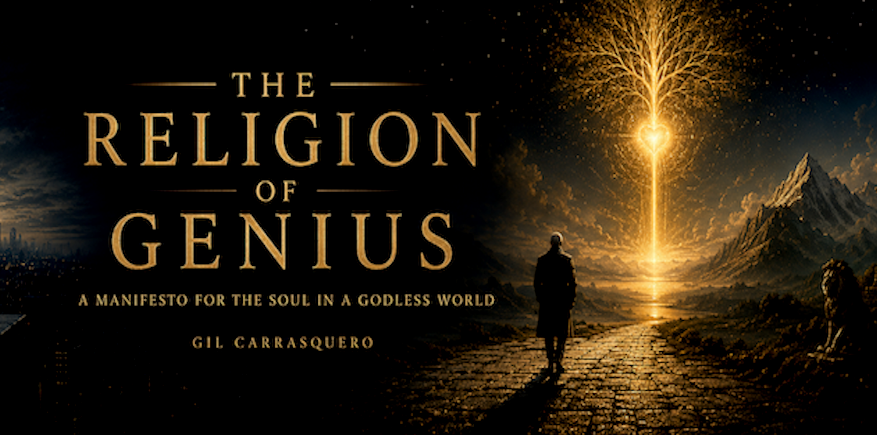
The Religion of Genius: A Manifesto for the Soul in a Godless World is the book I have been writing, in one form or another, for most of my adult life. It argues that what civilization has lost is not God exactly, but the inner authority that God once represented — and that recovering it requires something precise and demanding.
This newsletter is where that argument lives, week by week.
If something in what I’ve just written resonates — if you recognize in my story a version of your own — you belong here.
Welcome. Let’s embark together in the journey of a lifetime….
Gil Carrasquero
Originally published on Substack on 26 May 2026. View the original.