The Curse of the Betrayed Soul
The Destructivity of Unlived Creativity
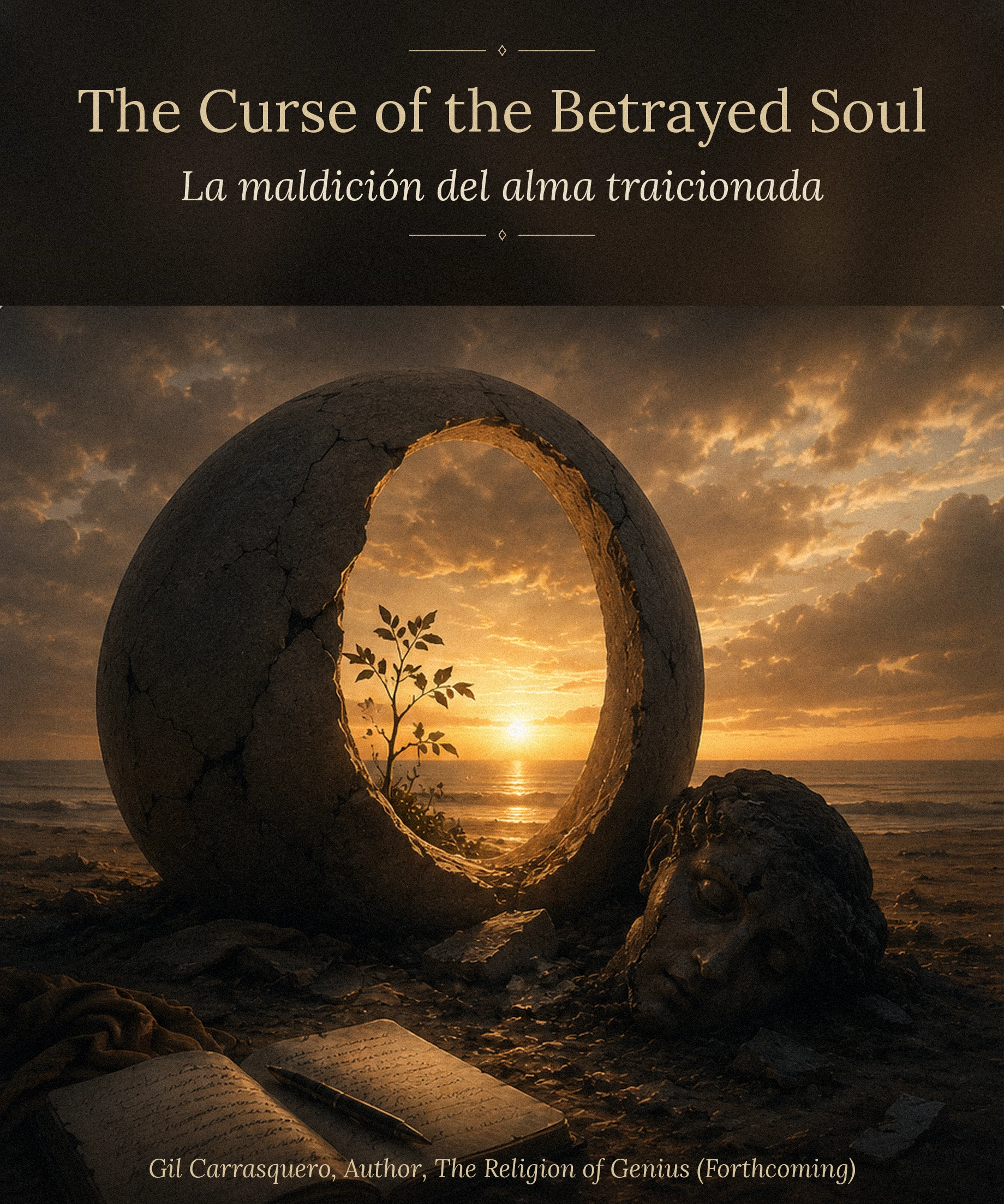
There is a poison no doctor can detect, because you are both the serpent and the bitten. It accumulates in lives that look correct from the outside. The career advances. The pictures look lovely, and yet a certain bitterness seeps through everything, a cynicism you have learned to call realism, a fatigue that no rest relieves. You have audited every external cause and found nothing, because the cause is not external. Something sacred you were given has been left in the dark too long, and what is left in the dark does not sleep. It ferments.
I know this drama because I am no stranger to it. For years I told everyone, myself included, that I was simply stuck. I flew across the world to trainings and conferences about the soul. I filled notebooks with quotations, reflections, and ideas for the work I would someday write. I sat in retreats of every flavor and color. I read Jung the way a man arriving from the desert finds fresh water. Just as I read López, Hillman, Stein, and Hollis, and everything orbiting around them, and each book gave me the strange relief of a man who studies maps to avoid the journey. I called it growth and healing. I called it seeking. It had the posture of devotion and the function of a hiding place. There is a spiritual neurosis almost no one names: the frantic accumulation of theory about the very thing you are refusing to do. I was not learning about the daimon. I was negotiating with it, offering it my erudition so it would stop asking for my life.
It did not stop asking. That is the first thing the poisoned must understand: the thing you avoid does not tire, does not forget, and does not accept substitutes, however successful or learned. My hiding place had a library inside it; yours may have a splendid office, a packed calendar, or a lofty reputation, but the architecture is identical, and so is the price you pay for inhabiting it in betrayal of your soul.
Jung named the law in twelve words: “Unlived life is a destructive, irresistible force that works softly but inexorably.” Softly is the word that should frighten you. Ruin rarely announces itself with a crash. It works like water under a foundation, patient, invisible, and certain of its inexorable end. What you refused to live does not vanish when you deny it; it goes underground, keeps its full strength, and begins working from below.
Otto Rank, the forgotten prodigy of Freud’s inner circle, watched this poison operate in the consulting room and gave the poisoned a scandalous name: the artist who does not create. He rejected the comfortable diagnosis of weakness. The stuck, the self-sabotaging, the endlessly self-analyzing are not fragile, Rank insisted; the neurotic’s strong will is exercised against himself. Read that again and understand what it accuses you of. All the voltage that was meant to carve something into the world, the same current that animates the ones history calls creators, is present in you, intact, and aimed inward. Self-sabotage is not the absence of power. It is power with the blade reversed, a sculptor who, denied marble, begins to chisel his own bones.
Why would anyone reverse the blade? Rank knew, and his answer cuts deeper than any inventory of childhood wounds. Because creation demands separation. Every act of self-creation requires a no spoken to a previous self, to a family script, to an identity that others have loved in you. To build the new life you must kill a version of yourself that feels familiar and that people still applaud. That killing produces guilt, and beneath the guilt, the oldest thing of all: fear.
Jung knew exactly what that fear is. In Symbols of Transformation he refused to treat it as one emotion among others and named it in full, like a man entering an indictment into the record:
“The spirit of evil is fear, negation, the adversary who opposes life in its struggle for eternal duration and thwarts every great deed, who infuses into the body the poison of weakness and age through the treacherous bite of the serpent; he is the spirit of regression, who threatens us with bondage to the mother and with dissolution and extinction in the unconscious. For the hero, fear is a challenge and a task, because only boldness can deliver from fear. And if the risk is not taken, the meaning of life is somehow violated, and the whole future is condemned to hopeless staleness, to a drab grey lit only by will-o’-the-wisps.”
Read the indictment slowly, because it names you. Evil, for Jung, does not reside in some distant atrocity: it lives in the backward pull, in dissolution, in never having risked. The serpent from the opening of this essay now has a name, and the name is your own refusal. And the grey Jung promises to the one who does not risk is recognizable too: it is the color of the waiting room where the unlived life sits, screen in hand, telling itself the timing is not right.
James Hollis distilled half a century in the consulting room into a single discipline: learn what your fear makes you do, and what it keeps you from doing. One face of fear guards the organism, the ancient sentry at the cliff edge. The other guards the false self: it dresses itself as prudence, as timing, as responsibility, and amputates your life one deferral at a time. And the first thing it amputates is courage, which comes from cor, the heart; Rollo May knew why that etymology matters: courage is the organ that pumps blood to every other virtue, and without it love pales into dependency, fidelity into conformism, and the threshold goes uncrossed. The neurotic and the artist tremble at the same door, with the same fear, the same serpent coiled on the same step. One crosses, heart first, and the fear becomes the task. The other converts the trembling into a residence and furnishes it, year after year, with rumination.
It fell to Marie-Louise von Franz, who worked beside Jung for nearly three decades, to write the clinical epitaph. Unused creative power, she said, is among the most wicked and destructive forces in the psyche; the energy of the unexercised gift turns to sheer poison, and many of the conditions we call neuroses are in truth higher possibilities that were never lived. The symptom you have spent years medicating, managing, explaining to therapists and apologizing for at dinner may not be a deficit at all. It may be your summit, inverted. Not every symptom is a summons; there is suffering that is illness, trauma, chemistry, or grief, and it deserves its own name and its own physician. But neither is every symptom a simple malfunction. The depression that visits at the height of your success, the rage without a proportionate object, the obsessive loops that devour your nights: these may be the exact weight of the thing you were built to carry and have refused to lift.
Psychology can map this mechanism down to its last gear. What it cannot do is tell you who assigned it to you. Because a possibility does not poison you unless it was yours by assignment. Energy does not turn wicked unless it was consecrated to something and betrayed. Follow that logic one step past where the clinic ends, and the floor begins to turn sacred beneath your feet. The old world had a name for the one who assigns and consecrates: the Daimon, the summons you did not choose, the pattern that arrived with you and has been arranging your fascinations, your recurring wounds, your unreasonable loves, since before you could speak. What Jung called unlived life and von Franz called poisoned gift and Rank called the uncreated art is one thing seen from three angles: a soul in breach of its own covenant. The curse is not that you failed to optimize your potential. The curse is that something sacred was entrusted to you and you have spent years calling its revenge a disorder.
Which means the exit cannot be management. I can testify it cannot be knowledge either; I tried knowledge for years, and the poison read every book with me. You do not negotiate with a betrayed god; you return to the altar. The tension Rank saw wrecking the neurotic is the same tension that builds the creator, and it resolves in one direction only: outward, into form, into an opus. Not a hobby, not a side project, not self-expression as decoration. This is the center of the religion I was broken into more than persuaded of: create the opus that will create you. The poison and the medicine are the same substance; the serpent knew it all along. Refused, your gift dismembers you slowly from within. Incarnated, it dismembers the person you never were, and hands what remains, at last, to the world.
The Daimon has been keeping the ledger all along, softly, inexorably. Now you know. How much longer will you let the account run?
— Gil Carrasquero / The Religion of Genius
Originally published on Substack on 17 August 2026. View the original.