The Wound and the Workshop
On loneliness, solitude, and the difference an entire destiny hangs on
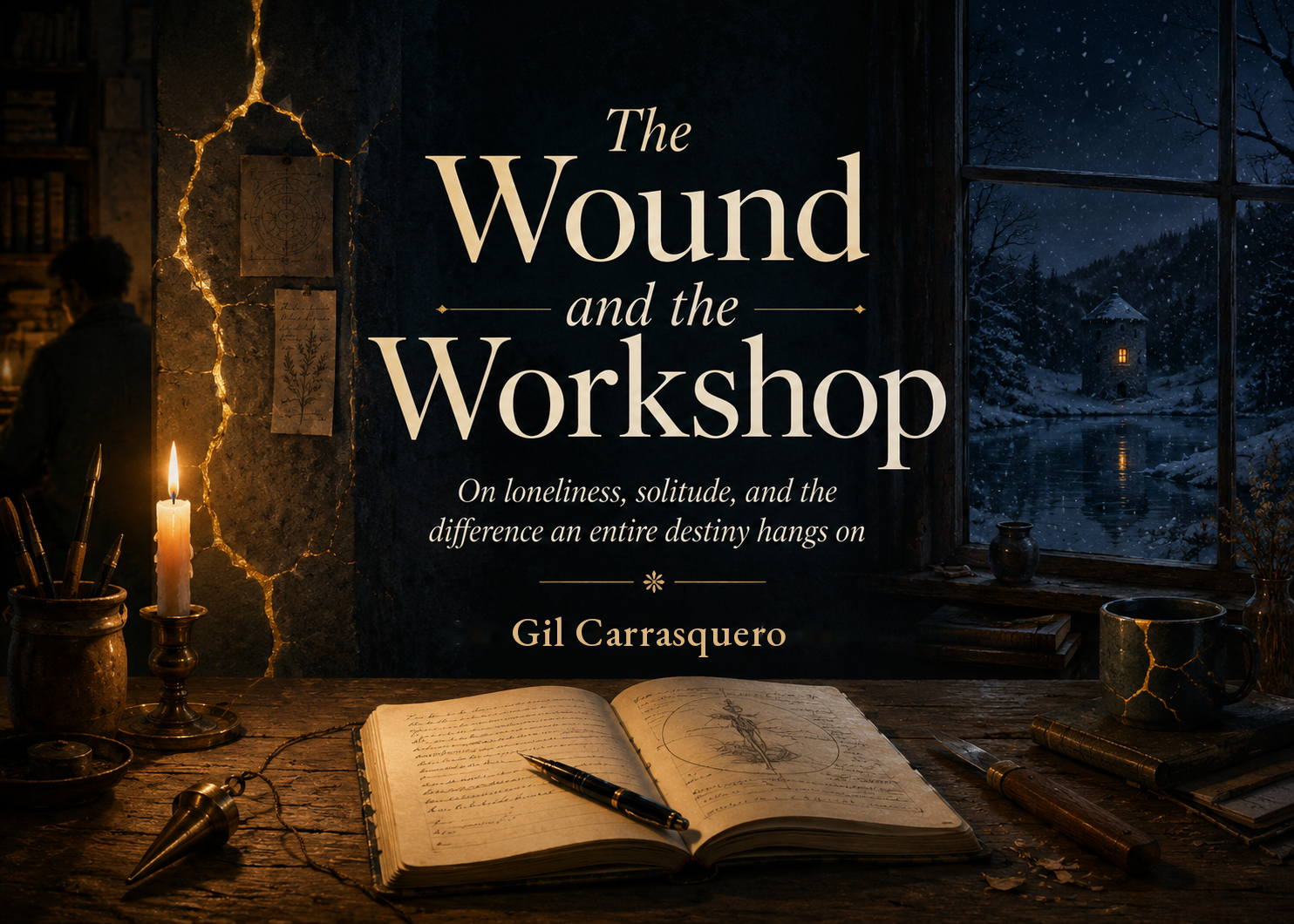
It is Friday night in Toronto. A young woman comes home from work, slides a frozen pizza into the oven, lights a candle, and pauses at the window to watch the snow. Then she eats on the couch, in front of the television. Nothing else happens. She films all of it and posts it with a caption that reads like a provocation: this is how a single woman with no children and no friends spends her Friday. Seven million people have watched it.
The number proves no approval, only that something was touched. In that candle lit against the snow, millions recognized a room they already inhabit, fear inhabiting, or secretly suspect they desire.
The reaction arrived on schedule. She and women like her were called symptoms of an epidemic, propagandists of a diminished life, romanticizers of isolation. They answered, with some perplexity, that the diagnosis had missed its patient: we never described ourselves as lonely, one of them said. And there the dispute stalled.
It stalled, curiously, in one of the few languages that keeps two words for this territory. English distinguishes loneliness from solitude, and still the two camps talked past each other, which proves the confusion was never a matter of vocabulary. Marianne Moore had already compressed the entire matter into six words: the cure for loneliness is solitude. The words survive in the dictionary while the experiences they name have collapsed into each other. So let me restore the border. Loneliness is the condition of the one who knows himself different and bleeds for it. Solitude is the craft of the one who turns that difference into a workshop. Everything I know about this subject fits inside that distinction, and in the passage from the first to the second an entire destiny can be decided.
The first we all know, though few confess it. It belongs to the one who discovered one day, almost always in childhood, that the truest part of his experience was precisely the part that could not be said. That he had seen, felt, or understood something for which the family table had no cutlery. That discovery founds an exile. The child learns to translate himself: he presents, in the common tongue, a customs-cleared version of who he is. The adult perfects the translation until the original is misplaced, and lives thereafter among men as the ambassador of a country he no longer visits. He smiles, functions, belongs, while bleeding drop by drop through everything left unsaid.
I know that customs house from the inside. I spent decades speaking fluently in languages that were not mine: the language of banks, of politics, of the analysis that explains everything and touches nothing. I was a decorated ambassador. And whoever has lost a country in the literal sense, with passport and border and scattered family, learns sooner or later that there is another country that can also be lost, an interior one, and that this second loss appears in no newspaper and receives no condolences. The exile I am writing about here, I write in both inks.
There are loud forms of this exile and silent forms, and the silent ones are usually worse. The married man who has not spoken an entirely true sentence in decades. The capable woman whose full calendar is a system of dikes. The admired professional who no longer remembers what he wanted before he learned to want what was expected of him. None of them is alone according to the census; all of them are according to the soul. If these lines feel familiar, you already know which exile I mean.
To this army of discreet exiles, the century prescribes more of the same: more noise, more exposure, more connection. The prescription aggravates the disease. Company is precisely what abounds in this age of connected multitudes, and the hunger persists untouched in the middle of the banquet. There are dinners of twelve more depopulated than an empty room, because the distance that hurts is not measured in bodies, and no accumulation of presences can reach the one who is absent from himself. The exile does not need another embassy. He needs to return to his country.
Solitude is that road home, and two men walked it with such radicality that they left maps.
On the fourth of July, 1845, while his country celebrated with gunpowder its independence from an empire, a twenty-seven-year-old man moved into a one-room cabin he had built beside a pond in Massachusetts. Henry David Thoreau fled to no wilderness: the village was near and friends came to visit. The distance he sought could not be measured in miles. He went to the woods, he wrote, because he wished to live deliberately, to front the essential facts of life, and not to discover, when it came time to die, that he had not lived. The sentence is quoted so often it has lost its danger. To live deliberately implies that most ordinary existence is not lived that way: that it passes as a consented sleepwalking among duties we never chose, ambitions delivered to us already worded, and opinions we mistake for thoughts of our own. Against that collective sleep, Thoreau raised his cabin the way one builds a precision instrument.
What he found there disconcerts anyone expecting the hermit’s lament. He had never found a companion so companionable as solitude; we are often lonelier among men, he noted, than in our own chamber. Society seemed to him too cheap: we meet so frequently that we have no time to acquire any new value for one another. In his house there were three chairs: one for solitude, two for friendship, three for society. This was no doctrine against others. It was a doctrine of proportions.
During the winter he cut through the ice of Walden with cord and plumb line to sound the depth of the pond. The neighbors held it to be bottomless; he suspected that every reputation for the abyss conceals a laziness of measurement. He found the bottom: deep, but exact. The operation he performed on the water was the one he had come to perform on himself: to pass through the surface, descend below opinion, touch his own floor, and return with a measure. That measure is neither inherited nor delegated. Each of us goes down by his own rope or lives on rumors of his depth.
Almost seventy years later, on the other side of the ocean, the descent took a darker form. In 1913, Carl Gustav Jung possessed everything a biography can display: family, professorship, prosperous practice, international fame. He had just broken with Freud and with the future the master had imagined for him. Then the ground gave way. On a train, awake, he saw Europe drowned in blood up to the line of the Alps. The visions returned. He heard voices he did not recognize as his own. The edifice of his science, built precisely to explain such things when they happened to others, had not a single room to house them when they happened to him. For months he lived with the question no psychiatrist wants to ask in the first person. It has been said he kept a revolver in his nightstand. What he did then remains one of the strangest acts of courage in the history of psychology: instead of fleeing into work, distraction, or company, he decided to descend deliberately toward what was assaulting him. When the last patient left, he closed the door, let the images come, and recorded them with the calligraphy and patience of a medieval monk. The book that rose from that descent opens with an invocation: my soul, where are you? Do you hear me? I speak, I call you. I have returned. Whoever calls his soul that way confesses he had abandoned her. He had traded her, he would later say, for the spirit of the times, the one that grants reality only to the useful, the visible, and the measurable.
Years later he raised with his own hands a stone tower beside the lake of Zürich, without telephone, electricity, or running water. There he pumped water from the well, split firewood, and lit oil lamps while half the world requested his attention. At Bollingen, he wrote, he was in the midst of his true life. This was not the eccentricity of a sage: it was a material liturgy. Every convenience exempts us from a gesture, and some of the gestures we have been exempted from were, for millennia, the threads that stitched the human being to the earth, to the body, and to his own depths.
At the end of his life he left an essential definition: loneliness does not come from having no people around us, but from being unable to communicate the things that seem important to us, or from holding thoughts that others find inadmissible. If loneliness is measured in withheld words and not in empty chairs, it is not cured by accumulating presences: it demands interlocution. And the first pending interlocution, the one that has been waiting years for an audience, is not with another.
The pond and the tower were chambers of that audience. Thoreau lowering his plumb line through the ice, Jung calling to his soul as to an abandoned wife: both stopped interrogating the door and turned toward the room, by pure craft. They understood that the difference which had wounded them was the very material they were meant to work.
The material reaches us in disorder. The grievance arrives fused with our reaction to the grievance; desire comes alloyed with implanted desires; vocation comes mixed with the father’s fear, the mother’s ambition, and the strategies we invented in order to belong. All of it accumulates in that gray mass we call, with accidental precision, being a mess. On that confusion no life of one’s own can be built. What is needed is a knife to separate the received from the chosen, what happened from what it means, what is expected of us from what silently claims us. And what is needed is a sealed vessel in which to make the cut, because in the presence of others the mixture keeps receiving ingredients: expectations, roles, reflections. The gaze of another, even a loving one, alters what it sees. Solitude is that vessel.
Let no one say the vessel is hospitable. Whoever enters the workshop expecting the peace of the brochures finds first the tedium, the murmur of everything postponed, the daily temptation to flee toward the phone or toward any voice at all. There are whole weeks without gold, months in which the table returns only lead and shame. The fire of the art was slow by necessity, not by aesthetics. But it is there, with the world in suspension, that the soul can finally spread its life across the table and begin to separate: this I was told, this I felt, this I fear, this I inherited, this I am. From outside, the operation lacks all epic: it looks like a man measuring a pond, an old man splitting wood, a woman having dinner by a candle. Inside, something ancestral is taking place. A human being is distilling his essence from the mass of his circumstances.
Then the distinction between loneliness and solitude reveals its floor. The one who bleeds suffers his difference as impurity and would extract it in order to be, at last, like everyone else. The one who works discovers that the difference was the essence: what the family table could not receive, what no common tongue could house, was never the defect but the gold. He spent half a life apologizing for his only patrimony.
The wound and the mine were the same place.
But separating was the condition, not the goal. Only what has learned to exist on its own can truly meet another; what was never distinguished does not unite, it tangles. A good part of what we call love consists of two deprivations trying to spare each other the labor of self-knowledge, and two shipwrecks do not make a shore. Rilke wrote it to a young poet who asked him about love: that two solitudes protect, and border, and greet each other. Two beings capable of greeting one another from territories of their own.
That is why the workshop does not close the world: it prepares it. Thoreau left Walden after two years, saying he had other lives to live, and returned to the village with a book taking shape and an interior measure against which to weigh the world’s coins; he lived among his neighbors so undomesticated that he spent a night in jail rather than fund with his taxes a war he judged unjust. Jung was all his life a pendulum between the physician’s house, full of patients and family, and the soul’s house, full of silence. He knew that whoever settles permanently in the depths no longer descends into them: he drowns. The gold found below must return to the surface. There is a solitude that prepares one for the world and another that armors one against it; both speak the same vocabulary and are told apart by their direction. The vessel is judged by what it finally pours.
Let me return for a moment to the candle in Toronto. Seen from this side of the essay, it no longer illuminates the scene of a lack: it illuminates the window of a workshop. I do not know what that woman separates on her Fridays of snow, or what her vessel will pour. I know that millions stopped before her light the way the night traveler stops before the only lit window in the village, and that the stopping was already a confession.
What the workshop returns, moreover, is not a private possession. The distilled difference arrives as responsibility, not as trophy: it is the particular form that life has been trying to take through us, the note our existence, and no other, was called to play. Talent can serve the ego; genius demands obedience. That is why the workshop does not simply produce identity: it produces vocation. The recovered country must one day open its ports.
There remains the matter at its true scale, which is the scale of destiny. The deepest choice does not occur between solitude and company: it occurs between the wound and the workshop. The difference we are admits no return to sender. It can become perpetual foreignness, a translated life that functions from its embassy while the native country grows over with weeds. Or it can become workshop: table, plumb line, knife, slow fire; the place where the strange ceases to be defect and acquires form. You know, without being told, how much unworked material waits for you in the half-light, which interior conversation has been requesting an audience for years, which difference is still bleeding because it has not yet been laid on the table. The workshop door has no lock and never had one.
It has a price, and the price has been the same since the origin:
you enter alone.
Originally published on Substack on 9 August 2026. View the original.